

How Security Deposits Work in Florida: A Complete Guide for Landlords
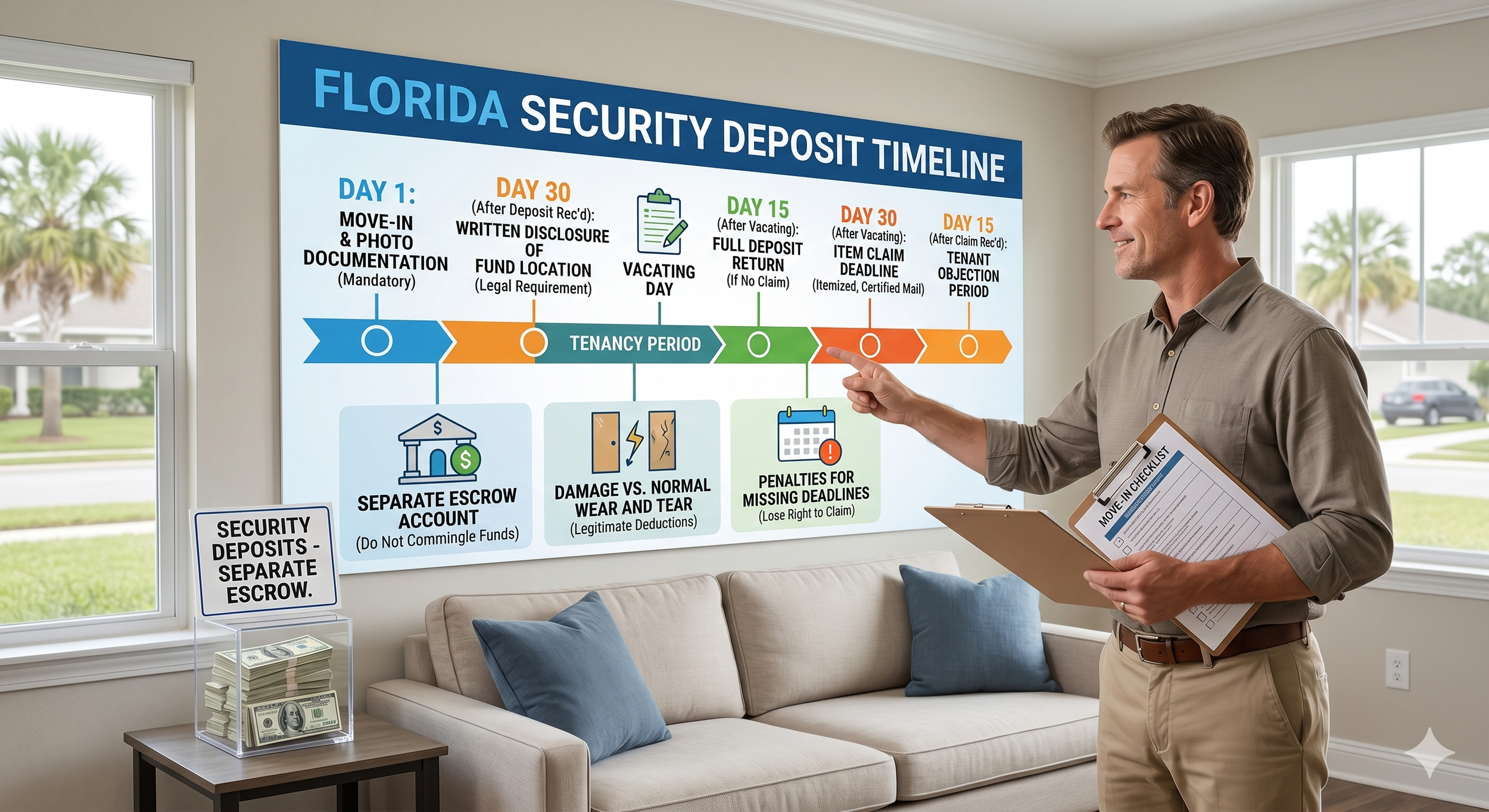
How do security deposits work in Florida for rental property owners? Florida law under Chapter 83.49 of the Florida Statutes governs every aspect of residential security deposits — how they must be held, what disclosures are required, what you can legally deduct, and the exact timelines for returning them. Miss any of these requirements and you can lose your right to make deductions entirely.
Security deposits are one of the most misunderstood and mishandled areas of Florida landlord-tenant law. Most landlords know deposits exist to protect them financially — but far fewer know the specific rules that govern how deposits must be held, what written disclosures are required, what the difference is between damage and normal wear and tear, and what happens if they miss a deadline.
The consequences of getting this wrong aren't minor. Under Florida law, a landlord who fails to follow the statutory requirements can forfeit their entire right to make a claim against the deposit — even if the tenant caused genuine damage. In some cases, a court can also order the landlord to pay the tenant's attorney fees and court costs.
This is one area where knowing the rules before you need them is essential.
How Much Can You Charge for a Security Deposit in Florida?
Florida law places no statutory cap on security deposit amounts for residential rentals. There's no statewide limit on how much a landlord can require. In practice, most landlords in Jacksonville and across Northeast Florida charge the equivalent of one month's rent, though a higher deposit may be appropriate depending on the applicant's credit history, rental background, or other qualifying factors.
CrossView Property Management typically charges a deposit equal to one month's rent — with the flexibility to require more based on the tenant's credit and rental history. For properties renting under $1,000 per month, a minimum deposit of $1,000 applies. If a tenant is approved with pets, a separate $250 non-refundable pet fee is collected per pet prior to move-in.
One note worth making: while Florida doesn't limit the deposit amount, charging an unusually high deposit without basis can work against you in a competitive rental market. The goal is protection, not a barrier to good tenants.
How You Must Hold the Security Deposit
This is where a lot of landlords — especially self-managing owners — run into trouble. Florida law doesn't allow you to deposit the security deposit into your personal checking account or comingle it with your operating funds. There are three legally approved methods for holding a Florida security deposit:
Option 1: A separate non-interest-bearing account — held in a Florida bank, in a separate account from your own funds, designated specifically for security deposits.
Option 2: An interest-bearing account — held in a Florida bank, with the interest earned going to the tenant (or to you if you've posted a surety bond).
Option 3: A surety bond — a bond posted with the Clerk of the Circuit Court for the county where the property is located, in an amount equal to the deposit plus any interest owed.
Most residential landlords in Jacksonville use Option 1 — a separate non-interest-bearing account. The key word is "separate." Commingling deposit funds with your own money is a violation of Florida law.
The 30-Day Written Notice Requirement
Here's a requirement that catches a lot of first-time landlords off guard: within 30 days of receiving the security deposit, you must provide the tenant with written notice of where and how the deposit is being held. That notice must include which of the three methods you're using, the name and address of the institution holding the funds, and whether the account bears interest.
This disclosure can be included in the lease agreement itself or provided separately in writing. Either way, it has to be done within 30 days. Failing to provide this notice is a common mistake — and while it doesn't automatically forfeit your deposit rights, it creates legal exposure in any subsequent dispute.
What You Can and Cannot Deduct
This is the section most landlords need to understand thoroughly before a tenant ever moves out, because the distinction between legitimate deductions and impermissible ones is one of the most common sources of dispute.
What you CAN deduct:
Unpaid rent remaining at the end of the tenancy is always a permissible deduction. Beyond that, Florida law allows deductions for damage beyond normal wear and tear — but that phrase carries a lot of weight.
Legitimate damage deductions include things like large holes in walls, broken windows, damaged or missing fixtures, heavily stained or burned carpet, pet damage to flooring or walls, unauthorized alterations to the property, and excessive cleaning costs when a tenant leaves the home in significantly worse condition than they received it.
What you CANNOT deduct:
Normal wear and tear is not deductible — and Florida defines this as deterioration that occurs naturally through ordinary use of the property over time. Specific examples that courts and Florida law consistently treat as normal wear and tear include: faded or lightly scuffed paint from sunlight or everyday contact, small nail holes from picture hanging, gently worn carpet in high-traffic areas, loose door handles from regular use, minor scuffs on baseboards, and gradual discoloration of bathroom or kitchen fixtures.
The line between damage and wear and tear can be genuinely gray in some situations — carpet that's worn versus carpet that's stained; paint that's faded versus paint that's been marked up. This is why thorough move-in documentation matters so much. When there's no photographic baseline, disputes become word-against-word situations. And in those situations, Florida courts tend to give the benefit of the doubt to tenants.
Painting is a particularly common trap. Florida landlords may only deduct painting costs when the damage goes beyond normal wear and tear. Routine repainting to keep a unit in rentable condition is considered standard maintenance — not a tenant's financial responsibility. A landlord who tries to charge a tenant for repainting simply because the walls look lived-in will lose that deduction if the tenant disputes it.
The Timeline for Returning or Claiming the Deposit
This is the section with the most financial consequences for landlords who aren't paying attention. Florida's return and claim timelines are strict and unforgiving.
If you're returning the full deposit: You must return it within 15 days after the tenant vacates and surrenders possession of the property. No exceptions, no extensions.
If you intend to make deductions: You must send the tenant written notice of your intent to claim a portion of the deposit within 30 days of the tenant vacating. This notice must be sent by certified mail to the tenant's last known address and must itemize each deduction with a specific dollar amount for each item.
If you miss the 30-day deadline: Florida law is unambiguous — you forfeit your right to make any deduction from the security deposit. It doesn't matter how legitimate the damage was or how well-documented it is. If the notice doesn't go out within 30 days, the tenant is entitled to the full deposit back.
After the tenant receives your notice: The tenant has 15 days to object in writing to any disputed deductions. If they don't object within 15 days, you may deduct the amounts stated in your notice and return the remainder. If they do object, the dispute may need to be resolved through mediation or in court.
What Happens When Disputes Go to Court
If a landlord wrongfully withholds a security deposit — either by failing to follow the statutory procedure or by making impermissible deductions — a Florida court can order the return of the full deposit plus the tenant's court costs and reasonable attorney fees. That's a significant financial exposure that often far exceeds the deposit itself.
The reverse is also true: if a tenant wrongfully objects to a valid claim and a court sides with the landlord, the tenant may be responsible for the landlord's legal costs.
The best way to avoid court entirely is documentation, timeliness, and a clear understanding of what's deductible before the tenancy ever begins. Every owner we work with at CrossView Property Management benefits from professionally executed move-in and move-out condition reports, which give us the documentation needed to support legitimate deductions and defend against unfair disputes.
How CrossView Handles Security Deposits
CrossView Property Management holds all security deposits in a separate escrow account in strict compliance with Florida law. We handle the initial 30-day written notice to tenants, the move-in documentation that creates the baseline for any future claim, the itemized claim notice at move-out when deductions are warranted, and the timely return of remaining deposit funds.
We also don't mark up repair costs associated with deposit claims — owners pay actual vendor costs, and we document everything in your owner portal so you always have a clear record.
If you're self-managing a rental property in Jacksonville, Orange Park, Fleming Island, St. Augustine, Nocatee, or anywhere in Northeast Florida and you're unsure whether your current deposit procedures are fully compliant with Florida law, it's worth a conversation. Getting it right from the start is far less expensive than a deposit dispute after the fact.
CrossView Property Management 📞 904-855-7933 ✉️ rentals@crossviewpm.com www.crossviewpropertymanagement.com
Frequently Asked Questions
Q: How much can a landlord charge for a security deposit in Florida? A: Florida law does not cap the security deposit amount for residential rentals. Most landlords in Jacksonville and Northeast Florida charge the equivalent of one month's rent, though a higher amount may be appropriate based on the tenant's credit or rental history. CrossView Property Management charges one month's rent as the standard deposit, with a minimum of $1,000 for properties renting below that amount.
Q: How long does a Florida landlord have to return a security deposit? A: If you're returning the deposit in full with no deductions, Florida law requires you to return it within 15 days of the tenant vacating and surrendering possession. If you intend to make any deductions, you must send a written itemized claim to the tenant within 30 days — by certified mail to their last known address. Miss the 30-day deadline and you forfeit your right to make any deductions, regardless of actual damage.
Q: What can a Florida landlord deduct from a security deposit? A: Permissible deductions include unpaid rent, damage beyond normal wear and tear, excessive cleaning costs, and replacement of fixtures or items the tenant damaged or removed. You cannot deduct for normal wear and tear — meaning routine deterioration from ordinary use, such as faded paint, small nail holes, gently worn carpet, or loose door handles. Florida courts interpret this distinction strictly, and documentation at move-in and move-out is essential to supporting legitimate deductions.
Q: What happens if a Florida landlord doesn't return the security deposit on time? A: A landlord who fails to return the deposit within 15 days (when no deductions are claimed) or fails to send a written itemized claim within 30 days (when deductions are intended) forfeits the right to make any deductions. If a court finds the deposit was wrongfully withheld, the landlord may also be ordered to pay the tenant's court costs and reasonable attorney fees — often exceeding the deposit amount itself.
Q: Does CrossView Property Management hold security deposits in Florida? A: Yes. CrossView holds all security deposits in a separate escrow account in full compliance with Florida Statute 83.49. We handle the required 30-day written notice to tenants, move-in and move-out condition documentation, itemized claim notices, and timely return of deposit funds. Property owners across Duval, Clay, and St. Johns counties can reach us at 904-855-7933 or rentals@crossviewpm.com.