How to Calculate ROI on a Rental or Investment Property in Florida: A Step-by-Step Guide for New Investors
How do I calculate the return on investment (ROI) for a rental or investment property — especially if I’m just getting started and looking at properties in Florida or Northeast Florida?
Quick Answer:
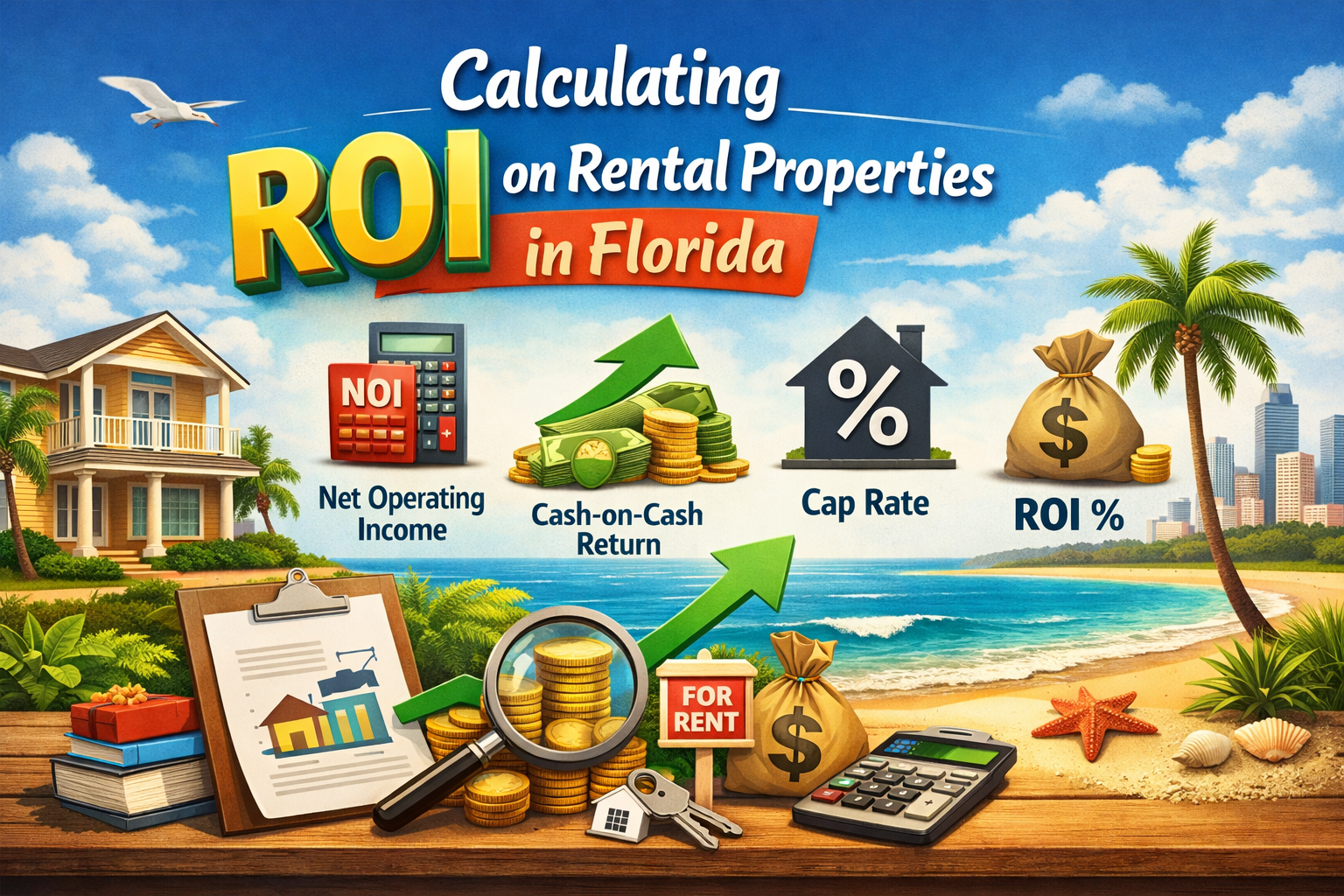
ROI (Return on Investment) measures how much profit you’re earning compared to how much money you’ve invested in a property. New investors should understand multiple ROI metrics — like cash-on-cash return, cap rate, and net operating income — to make smart rental decisions before buying in Florida.
Why ROI Matters for New Rental Property Investors
When you’re investing in real estate, ROI helps you answer a critical question: Is this property worth it financially?
Instead of guessing, ROI gives you a measurable way to:
Compare different properties
Evaluate long-term profitability
Avoid cash-draining investments
Build confidence as a first-time investor
In a fast-moving market like Florida, where home prices, rents, and demand vary by location, understanding ROI is one of your most important tools.
Key ROI Metrics You Should Know
1. Net Operating Income (NOI)
NOI = Total Rental Income – Operating Expenses
Operating expenses include property taxes, insurance, maintenance, vacancy loss, and property management — but not your mortgage.
This is your baseline for understanding how much income the property generates before financing.
2. ROI (Basic Return on Investment)
ROI = (Annual Net Profit ÷ Total Investment) × 100
To calculate it:
Add up all your out-of-pocket investment: down payment, closing costs, and upfront repairs
Subtract total expenses (including financing) from rental income
Divide your net annual profit by your total investment
This gives you a clear profitability percentage based on your actual money invested.
3. Cash-on-Cash Return
Cash-on-Cash Return = (Annual Cash Flow ÷ Total Cash Invested) × 100
This is especially useful if you’re using financing. It tells you how much cash you're earning annually, compared to how much cash you put in.
If you invested $60,000 and your net cash flow is $6,000 per year, your cash-on-cash return is 10%.
4. Cap Rate (Capitalization Rate)
Cap Rate = (NOI ÷ Property Value) × 100
This metric ignores financing and shows how much income the property generates as a percentage of its value. It’s great for comparing properties in different areas — like Jacksonville vs. St. Augustine.
Example: Calculating ROI on a Florida Rental
Let’s say you’re buying a rental in Jacksonville for $300,000.
Down Payment + Closing + Repairs = $60,000
Monthly Rent = $2,500
Annual Rental Income = $30,000
Operating Expenses = $8,000
NOI = $22,000
Mortgage Payments = $14,000/year
Cash Flow = $8,000/year
Here’s how your ROI metrics break down:
ROI = ($8,000 ÷ $60,000) × 100 = 13.3%
Cap Rate = ($22,000 ÷ $300,000) × 100 = 7.3%
Cash-on-Cash Return = same as ROI if you financed with $60K down
These numbers help you make informed decisions — not emotional ones.
What’s a Good ROI for Florida Rentals?
Cap Rate: 5%–8% is common for long-term rentals in Florida
Cash-on-Cash Return: Aim for 7%–12%+
Short-Term Rentals (like vacation properties) may offer higher potential returns but come with more volatility, seasonality, and management costs
The Florida market can offer excellent ROI — but only if you do the math before buying.
What Can Hurt Your ROI?
Even strong properties can underperform if you overlook key variables. Watch out for:
Overestimating rent potential
Underestimating repairs or maintenance
Ignoring vacancies or seasonal slowdowns
Rising property taxes or insurance costs (especially near the coast)
Using poor tenant screening or inefficient management
ROI isn’t just about the property — it’s about how well you run it.
Tips to Improve Your ROI
Screen tenants thoroughly to reduce vacancies and damages
Raise rents strategically with market data
Minimize repairs through preventive maintenance
Refinance to lower your mortgage payment
Use professional property management to maximize returns without burning out
Final Takeaway
If you’re a new investor exploring Florida rental properties, learning how to calculate ROI is your first real step toward financial clarity. By mastering formulas like cash-on-cash return and cap rate, you’ll avoid costly mistakes — and build a portfolio that works for you.
👉 Want to test your own numbers on a real property?
Use the free ROI calculator on our sister company’s website to evaluate any Florida rental property:
https://www.crossviewrealty.com/roi-calculator