Is Renting Out Your Home Worth It? An Honest ROI Guide for Jacksonville Landlords
Is renting out your home in Jacksonville, Florida actually worth it financially? It depends on your specific numbers — mortgage payment, achievable rent, carrying costs, and long-term goals. For many Jacksonville homeowners, renting generates income, preserves an appreciating asset, and builds wealth over time. For others, particularly recent buyers at higher interest rates, the math requires a harder look before committing.
This is the question a lot of Jacksonville homeowners are sitting with right now. You own a home you're not sure you want to sell. The market isn't giving you the price you want, or you're relocating and want to keep the property, or you're simply asking whether renting makes more financial sense than sitting on an asset that isn't being used.
It's a legitimate question, and it deserves an honest answer — not a generic "real estate is always a great investment" response, but an actual breakdown of how to think about the numbers.
Start With the Right Question
Most homeowners approach this backwards. They start with a number they'd like to receive — usually whatever covers their mortgage — and then hope the rental market agrees. That's not how rental valuation works, and starting there almost always leads to disappointment.
The right question isn't "will this rent for what I need?" The right question is "what will this property actually rent for in today's market, and does that number work for my situation?"
Rental value in Jacksonville and across Northeast Florida is driven by supply and demand — what comparable homes in your specific area are renting for right now, current vacancy rates, and what the market will support based on your property's size, condition, location, and features. A home in Nocatee rents differently than a home in Middleburg or Green Cove Springs, even with similar square footage. A home in a master-planned community with amenities commands a premium that a comparable home in a standard subdivision doesn't.
An honest rental market analysis from CrossView Property Management — free, no obligation — gives you that number before you make any decisions. It's the starting point for every financial conversation that follows.
How to Calculate Whether Renting Makes Sense
Once you know what your home will actually rent for, the financial analysis is straightforward. Here's how to think through it.
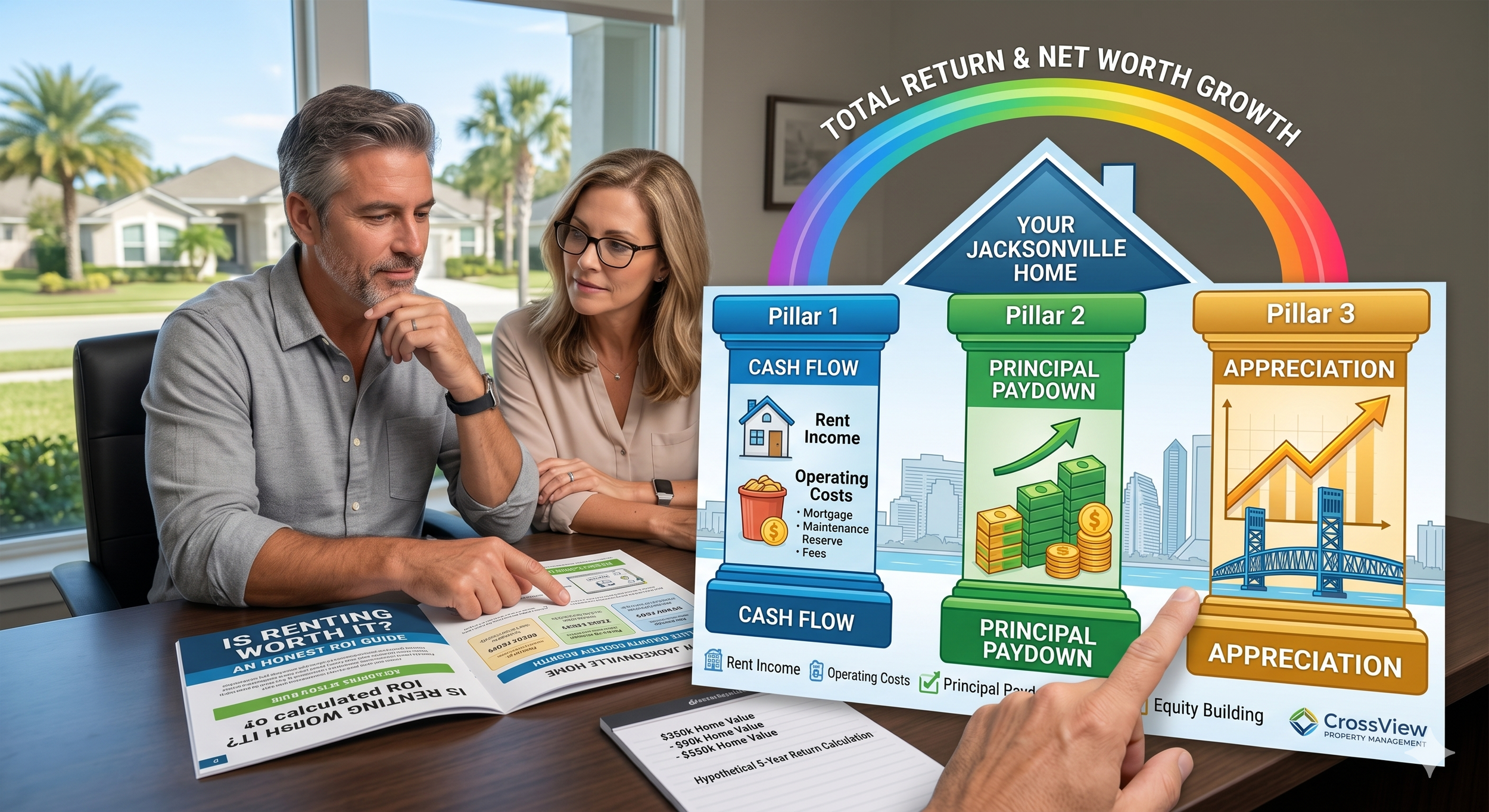
Monthly cash flow is the most immediate metric: rent minus all monthly costs. Those costs include your mortgage payment (principal, interest, taxes, and insurance), any HOA dues, property management fees if applicable, and a realistic reserve for maintenance and vacancy.
On the maintenance side, a common rule of thumb is to budget roughly 1% of the property's value annually for upkeep — so on a $350,000 home, that's about $292 per month set aside as a reserve. You won't spend it every month, but you'll need it when the HVAC needs replacing or the water heater goes out. Vacancy is also a real cost — even a well-managed property should be budgeted with one to two weeks of vacancy per year accounted for.
If your rent covers all of these costs and leaves something left over, you have positive cash flow. If rent covers all costs but leaves little surplus, you're roughly breaking even — which isn't a bad outcome if the other factors work in your favor. If rent falls short of your monthly costs, you have a negative cash flow situation that requires honest evaluation.
Cash flow isn't the whole picture. This is where a lot of first-time landlords make their analysis too narrow. Even in a break-even or modestly negative cash flow situation, renting can still make financial sense when you account for the other components of return.
Every mortgage payment includes a principal reduction component — you're paying down the loan balance and building equity, even when the rent check doesn't feel like a windfall. On a $350,000 home with a 30-year mortgage, the principal paydown in the early years may be $300 to $500 per month. That's real wealth accumulation that doesn't show up in monthly cash flow but absolutely shows up in your net worth.
Property appreciation is the other major factor. Jacksonville's real estate market has demonstrated steady long-term appreciation, and Northeast Florida's continued population growth supports ongoing demand for housing. Even conservative appreciation — 2% to 3% annually on a $350,000 property — represents $7,000 to $10,500 per year in equity growth. Over five or ten years, that compounds meaningfully.
Total return on a rental property is the combination of cash flow, principal paydown, and appreciation — not just the monthly surplus. When you account for all three, the picture often looks considerably better than the monthly cash flow number alone suggests.
The Current Reality for Recent Buyers in Jacksonville
Here's the honest part of this conversation that not everyone wants to have, but that CrossView believes you deserve to hear.
Homeowners who purchased in Jacksonville in 2022 or 2023 at higher interest rates are carrying larger monthly mortgage payments than buyers from earlier years — often $400 to $600 more per month on a comparable home than someone who bought in 2020 or 2021. In many cases, current rental market rates in their area don't fully cover that payment.
That doesn't automatically mean renting is the wrong choice. Some owners in that position still rent because the gap is manageable, because they expect to return to the area, because the property is in a strong appreciation market, or because selling right now would mean selling at a loss or at a lower price than they'd accept. All of those are legitimate reasons.
But it does mean the analysis needs to be done with accurate numbers, not optimistic assumptions. An honest rental valuation and a clear-eyed look at monthly carrying costs will tell you whether renting makes sense, whether selling is more logical, or whether holding and waiting for market conditions to improve is the right play.
Renting vs. Selling: How to Think About It
If you're on the fence between renting and selling, here's a useful framework.
Renting tends to make more sense when: the rental income covers most or all of your monthly costs, you plan to return to the area within a few years, the current sales market isn't delivering the price you need, you want to hold an appreciating asset rather than convert it to cash, or your property is in a high-demand rental area with strong tenant interest.
Selling tends to make more sense when: the gap between rental income and monthly costs is significant and ongoing, you need the equity from the sale to move forward financially, you have no intention of returning to the area, or managing a rental — even with professional management — doesn't fit your life right now.
Neither answer is universal. The right answer depends on your specific property, your specific mortgage, your specific financial situation, and your goals. What CrossView can tell you is what your home will actually rent for — and that's the number that makes every other part of this analysis possible.
What Positive ROI Actually Looks Like in Northeast Florida
For Jacksonville homeowners whose numbers work, renting out a home in Northeast Florida can be a genuinely strong investment over time.
Jacksonville's continued population growth, its military community generating consistent rental demand, its relatively affordable cost of living compared to South Florida, and its position as one of Florida's most economically active metros all support healthy long-term rental demand. Areas like Nocatee, Ponte Vedra Beach, St. Johns, and Orange Park attract well-qualified renters who stay long-term and take care of their homes. Properly screened tenants in these markets tend to be stable, which reduces turnover costs and keeps income consistent.
A property that cash flows even modestly — covering costs with a small surplus — combined with five years of principal paydown and modest appreciation can generate total returns that significantly outperform leaving that equity sitting dormant or redeploying it elsewhere.
But it starts with an honest number. And that's what we're here to give you.
Get Your Free Rental Analysis
CrossView Property Management serves property owners across Duval, Clay, and St. Johns counties. Whether you're in Jacksonville, Orange Park, Fleming Island, Middleburg, Green Cove Springs, St. Augustine, Ponte Vedra Beach, St. Johns, or Nocatee — we'll give you an accurate rental market analysis and a straight conversation about whether the numbers make sense for your property.
No pressure. No inflated estimates designed to win your business. Just honest information so you can make the right decision.
CrossView Property Management 📞 904-855-7933 ✉️ rentals@crossviewpm.com www.crossviewpropertymanagement.com
Frequently Asked Questions
Q: Is renting out your home in Jacksonville, FL worth it financially? A: It depends on the specific numbers for your property. If rental income covers your monthly costs — mortgage, insurance, taxes, HOA, and a maintenance reserve — and you account for the additional return from principal paydown and property appreciation, renting can be a strong long-term wealth-building strategy. For recent buyers at higher interest rates, the cash flow picture may be tighter, which makes an honest rental market analysis the essential first step before making any decisions.
Q: How do I calculate ROI on a rental property in Florida? A: Start with monthly cash flow: rent minus all expenses including mortgage, taxes, insurance, HOA, management fees, and a maintenance reserve. Then add the non-cash components of return — monthly principal paydown (which builds equity) and annual property appreciation. Total return is the combination of all three, not just the monthly surplus. A property that appears to break even on monthly cash flow can still generate strong total returns over a five-to-ten-year holding period.
Q: What is a good monthly cash flow for a rental property in Jacksonville? A: Many investors target a positive monthly cash flow of $100 to $300 or more per unit after all expenses. However, in a market like Jacksonville where appreciation is a meaningful part of total return, a break-even or modestly negative cash flow position isn't necessarily a bad investment — particularly if the property is in a strong appreciation area and the owner has a multi-year horizon. The key is going in with accurate numbers rather than assumptions.
Q: Should I rent or sell my Jacksonville home right now? A: If your rental income covers most or all of your monthly costs, you plan to return to the area, or the current sales market isn't delivering the price you need — renting often makes more sense. If the gap between rental income and monthly costs is significant, you need the equity to move forward financially, or managing a rental doesn't fit your life — selling may be the stronger move. CrossView Property Management provides free rental market analyses to help Jacksonville homeowners run the actual numbers before deciding.
Q: What expenses should I budget for when renting out my Jacksonville home? A: Budget for your full monthly mortgage payment (PITI), HOA dues if applicable, property management fees (typically 8–12% of monthly rent for full-service management), and a maintenance reserve of roughly 1% of the property's value annually — about $290/month on a $350,000 home. Also account for vacancy — even well-managed properties should be budgeted with one to two weeks of vacancy per year. Contact CrossView at 904-855-7933 or rentals@crossviewpm.com for a free rental analysis tailored to your specific property.