

Should You Leave the AC On in an Empty Rental in Florida?
Should you leave the AC on in an empty rental property in Florida?
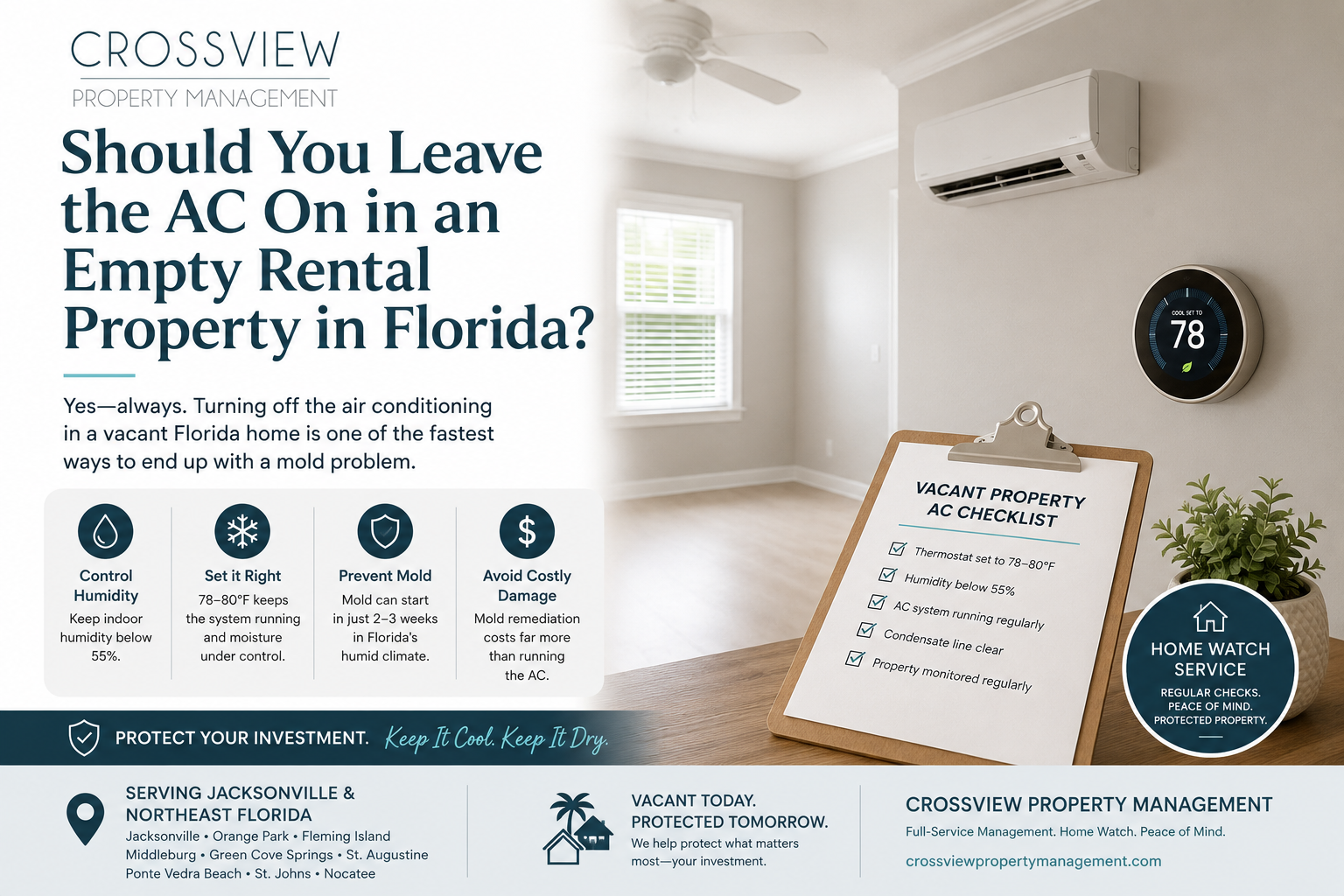
Yes — always. Turning off the air conditioning in a vacant Florida home is one of the fastest ways to end up with a mold problem, even if the house sits empty for just a couple of weeks. The goal isn't to keep the home cold. It's to keep humidity low enough that mold never gets a foothold.
Here's what that actually looks like, and why "just switch it off to save money" ends up costing owners far more than the electric bill would have.
Why Turning Off the AC Backfires in Florida
Florida's humidity doesn't pause because a house is empty. Without air conditioning actively running, indoor humidity climbs fast — and once relative humidity crosses roughly 55%, the mold spores that are already present in every home start colonizing drywall, wood trim, baseboards, and fabric. It doesn't take long. A property that sat vacant for two or three weeks with the AC off can develop a real mold problem before anyone walks back through the door.
This is one of the more expensive mistakes a rental owner can make, because mold remediation isn't a quick fix. It's drywall replacement, professional cleaning, sometimes flooring — and a delay in getting the property back on the market while it's handled.
What to Actually Set the Thermostat To
The AC doesn't need to run like someone's living there. It needs to run enough to keep pulling moisture out of the air. For most vacant Florida homes, that means setting the thermostat somewhere in the 78–80°F range — cool enough that the system cycles regularly and dehumidifies as it goes, without running full-time like an occupied home.
A few other things worth doing at the same time:
If the unit has a separate humidistat, make sure it's set to actively control humidity rather than left in a default or "off" position.
Have the condensate line checked before the property sits vacant for any length of time. Algae and sludge build up quickly in Florida's climate, and a clogged line can shut the whole system down — which defeats the purpose entirely.
A smart thermostat is worth the investment for owners who hold a property vacant more than occasionally. It lets you monitor and adjust remotely instead of hoping the setting held.
Why This Matters More for Vacant Properties Than Occupied Ones
An occupied rental has a tenant who'll notice if something feels off — musty smell, visible moisture, an AC that's not keeping up. A vacant property has no one to notice anything until someone opens the door for a showing or an inspection, and by then, humidity damage has had time to compound.
That's exactly why vacant properties need a different kind of attention than occupied ones — not less attention because no one's living there, but a different, more proactive kind.
How CrossView Handles Vacant and Seasonal Properties
This is a big part of what our Home Watch service exists to solve. For owners across Jacksonville, Orange Park, Fleming Island, Middleburg, Green Cove Springs, St. Augustine, Ponte Vedra Beach, St. Johns, and Nocatee who have a property sitting vacant — between tenants, during a renovation, or as a seasonal home — we check on climate control, humidity levels, and general condition on a regular schedule, not just when something already looks wrong.
A vacant property is still an asset that needs protecting. The fact that no one's living there doesn't pause that responsibility — if anything, it raises it.
The Bottom Line
Never turn the AC off completely in a vacant Florida rental. Set it to run consistently in the high 70s to low 80s, keep an eye on humidity specifically, and have the system checked before any extended vacancy. It's a small habit that prevents one of the more expensive problems a Florida rental owner can run into.
If you have a property sitting vacant right now and want a second set of eyes on it, reach out to CrossView Property Management for a free consultation on Home Watch and vacant property care.
Frequently Asked Questions
Q: What temperature should I set the AC to in a vacant Florida rental? A: Most vacant Florida homes do well with the thermostat set between 78°F and 80°F. That's cool enough for the system to cycle regularly and pull moisture out of the air, without running as hard as it would in an occupied home.
Q: Can I just turn the AC off completely to save money while the property is empty? A: No — this is one of the most common and costly mistakes Florida rental owners make. Without active cooling, indoor humidity climbs quickly, and mold can start developing on drywall, trim, and fabric in a matter of weeks.
Q: How do I know if humidity is a problem in a vacant rental? A: Keeping indoor relative humidity below roughly 55% is the general target. A smart thermostat or standalone humidity monitor makes this easy to track remotely, which matters most for a property no one's regularly walking through.
Q: Does CrossView Property Management check on vacant rentals? A: Yes. Our Home Watch service is built for exactly this — regular checks on vacant or seasonal properties across Duval, Clay, and St. Johns counties, including climate control and humidity, not just a visual walk-through.
Q: Is a vacant rental more at risk for mold than an occupied one? A: In a real sense, yes — not because vacant homes are more humid, but because there's no one there to notice early warning signs. That's why proactive monitoring matters more for vacant properties than occupied ones.