Are 2 Year Leases Legal in Florida?
Can you legally sign a 2-year lease on a rental property in Florida?
Yes—2-year leases are completely legal in Florida. But just because you can doesn’t always mean you should.
There’s No Law Limiting Lease Length
Let’s clear this up first.
In Florida, there’s no rule that says leases have to be 12 months or less.
You can structure a lease for:
6 months
12 months
24 months (or longer)
As long as both parties agree, it’s valid.
So legally? No issue.
The real question is whether a longer lease actually works in your favor.
Why Some Owners Consider 2-Year Leases
At first glance, it sounds like a win.
A longer lease can mean:
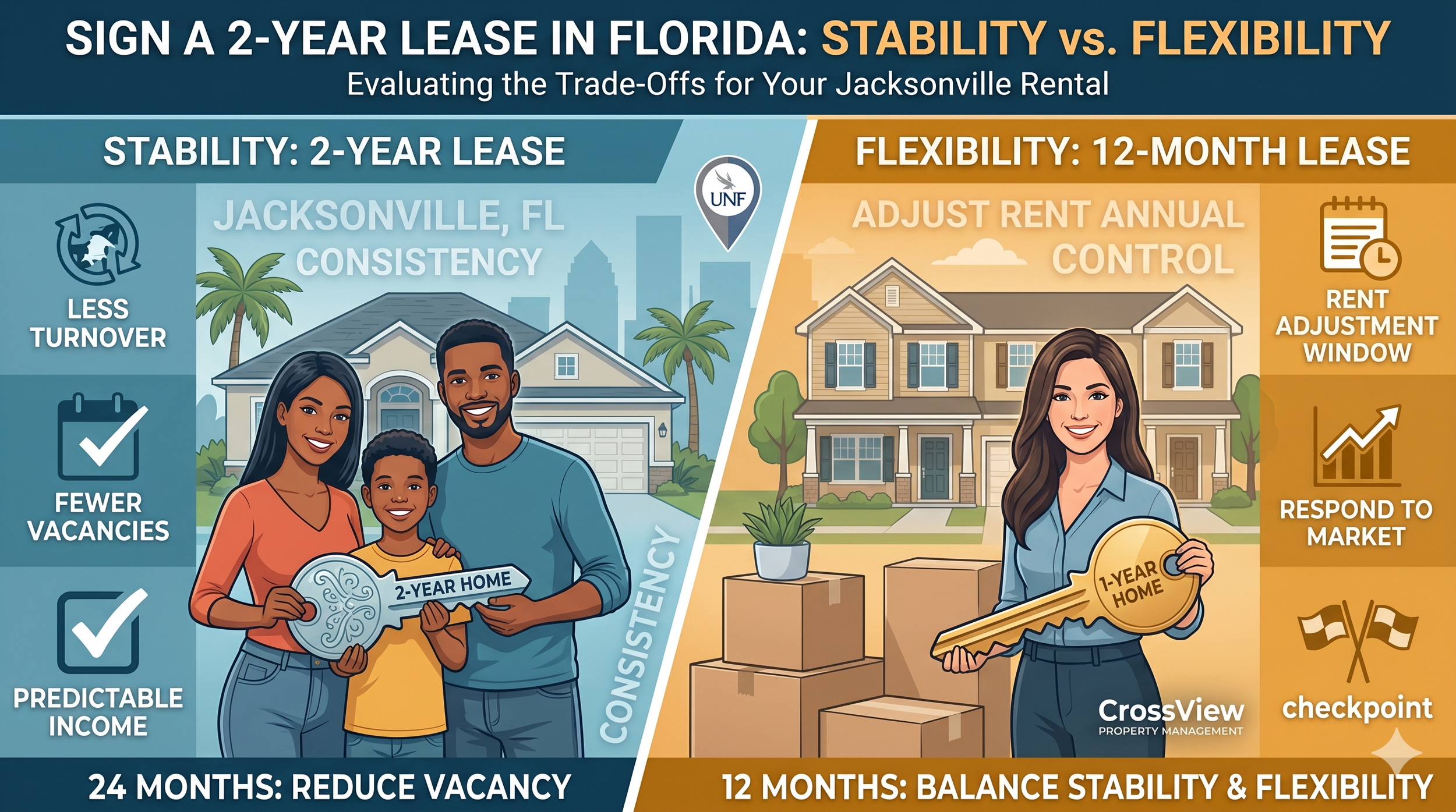
Less turnover
Fewer vacancy periods
More predictable income
And in the right situation, that can absolutely be true.
If you have a strong tenant who:
Pays on time
Takes care of the property
Plans to stay long-term
Locking that in for two years can bring a lot of stability.
Where It Starts to Get Risky
Here’s the part that doesn’t get talked about enough.
A 2-year lease doesn’t just lock in your tenant…
It locks in your terms.
That includes:
Rent amount
Lease conditions
Your flexibility
So if the market shifts—or you realize the tenant isn’t the best fit—you don’t have many options.
You’re committed.
Rent Increases: You’re Stuck (For Now)
This is one of the biggest trade-offs.
With a 12-month lease, you have the opportunity to:
Adjust rent annually
Respond to market changes
Keep up with rising costs
With a 2-year lease?
That adjustment window is gone until renewal.
So if rents increase in Jacksonville during that time, you’re potentially:
leaving money on the table.
Tenant Fit Matters Even More
A one-year lease gives you a checkpoint.
A two-year lease removes that.
So if something isn’t quite right:
Communication issues
Property care concerns
Just not a great fit
You’re dealing with it for a longer period of time.
That doesn’t mean it will go wrong—but the margin for error is smaller.
When a 2-Year Lease Actually Makes Sense
There are situations where it works well.
For example:
You have a highly qualified, stable tenant
The rental market is steady (not rapidly increasing)
You value consistency over flexibility
You’re trying to reduce long-term vacancy and turnover
In those cases, a 2-year lease can simplify things.
Less turnover. Fewer decisions. More predictability.
Jacksonville Rentals: What We Typically See
In the Jacksonville area, most leases still fall into the 12-month range.
Why?
Because it gives owners:
A yearly adjustment point
Flexibility with tenant decisions
A balance between stability and control
2-year leases happen—but they’re usually more selective, not standard.
A Middle Ground Most Owners Overlook
Here’s something worth considering.
Instead of jumping straight to a 2-year lease, some owners:
Start with a 12-month lease
Then renew for a longer term if the tenant proves to be a great fit
That way you’re not committing long-term before you’ve seen how things go.
It gives you flexibility upfront—and stability later.
So… Should You Offer a 2-Year Lease?
Here’s the honest answer.
If your priority is:
Stability
Reduced turnover
Locking in a great tenant
It can make sense.
But if you want:
Flexibility
The ability to adjust rent
A built-in decision point each year
A 12-month lease is usually the better route.
Final Thoughts
Yes—2-year leases are legal in Florida.
But the real decision isn’t about legality.
It’s about how much flexibility you’re willing to give up in exchange for stability.
If you’re not sure what lease structure makes the most sense for your property, we’re always happy to walk through it with you and help you make the right call.
👉 https://www.crossviewpropertymanagement.com/
FAQs
Q: Are 2 year leases legal in Florida?
A: Yes, Florida law allows leases longer than 12 months as long as both parties agree to the terms.
Q: Is a 2 year lease a good idea for rental properties in Jacksonville?
A: It can be, especially with a strong tenant, but many landlords prefer 12-month leases for flexibility and rent adjustments.
Q: Can landlords raise rent during a 2 year lease in Florida?
A: Typically no, unless the lease specifically allows it. Rent is usually fixed for the duration of the agreement.
Q: What are the risks of a 2 year lease?
A: Reduced flexibility, inability to adjust rent, and being locked into a tenant relationship for a longer period.
Q: Should I start with a 1 year lease before offering 2 years?
A: In many cases, yes. It allows you to evaluate the tenant before committing to a longer-term agreement.