Florida Lease Agreement Requirements: What Every Landlord Needs to Include
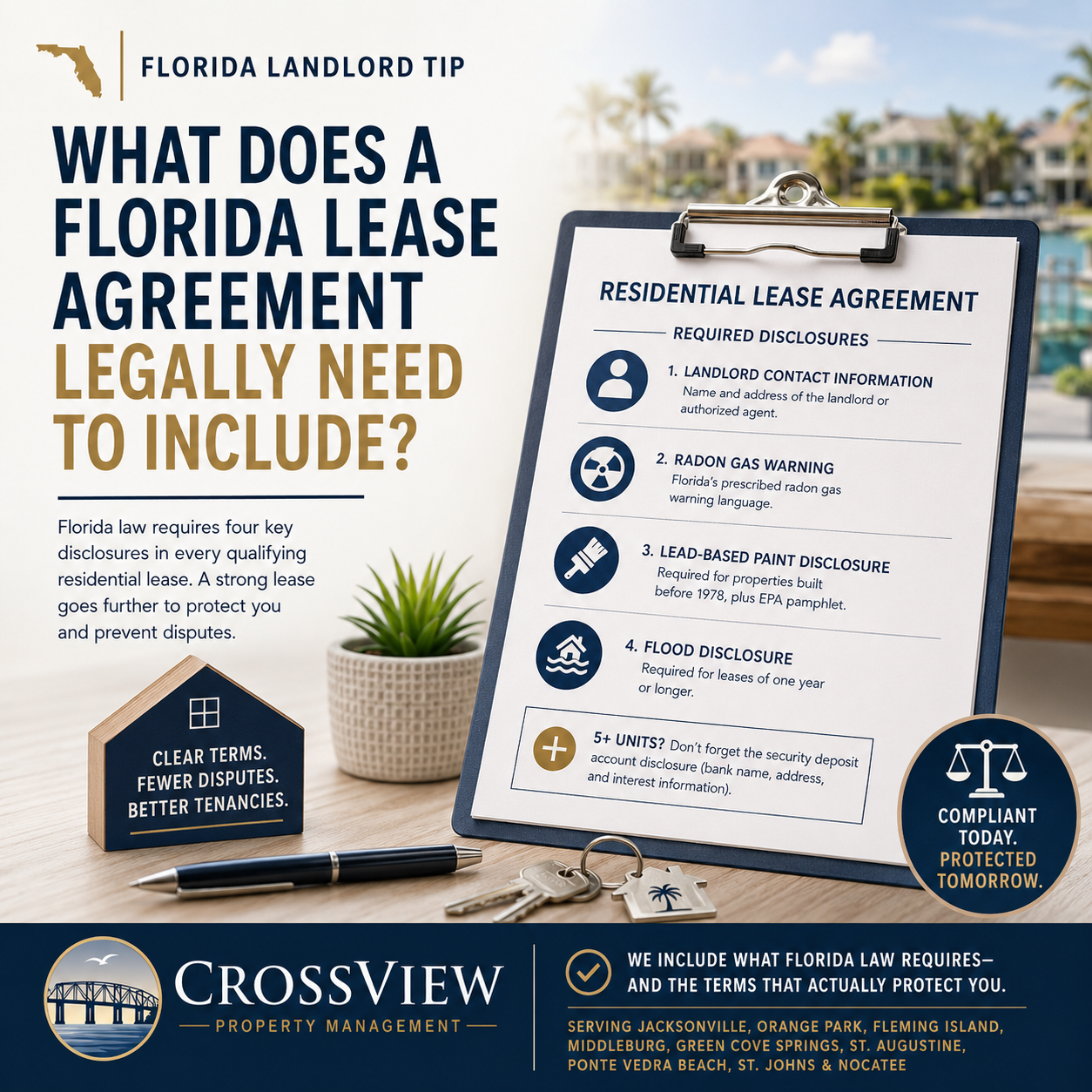
What does a Florida lease agreement legally need to include?
Florida law requires every residential lease to disclose the landlord's name and address, a radon gas warning, and — for homes built before 1978 — a lead-based paint disclosure. Leases of a year or longer also require a flood disclosure. Beyond those four, a solid lease should spell out rent, deposits, and maintenance responsibilities clearly enough that neither side is left guessing.
Let's break down what actually has to be in there — and what a lease should include even when the law doesn't require it.
The Four Disclosures Florida Law Actually Requires
Most landlords know they need "a lease." Fewer know exactly what has to be in it. Under Florida Statute 83.50 and related law, every qualifying residential lease needs:
Landlord or agent contact information. Florida Statute 83.50 requires you to disclose, in writing, the name and address of the landlord or whoever is authorized to receive notices and demands on your behalf. If a property manager handles this for you, the tenant still needs a valid address on file for things like repair requests and pay-or-quit notices.
A radon gas warning. This one surprises a lot of first-time landlords. Florida requires the state's prescribed radon gas language in every rental agreement, with no exception for the property's age or condition.
A lead-based paint disclosure. Required for any unit built before 1978, along with the EPA's lead hazard pamphlet. This is a federal requirement, not just a Florida one — but it applies to a meaningful share of Northeast Florida's older rental stock.
A flood disclosure. Required for any lease of one year or longer. It has to cover whether the landlord knows of prior flood damage, whether a flood insurance claim was ever filed, and whether the property received flood-related government assistance. Month-to-month and short-term leases are exempt.
If you rent out five or more units, add a fifth requirement: written disclosure of how you're holding the security deposit, including the bank's name and address and whether the account earns interest.
All four core disclosures are due at or before the lease is signed. Not after move-in. Not "whenever it comes up."
What Happens When a Lease Skips One of These
Here's the thing about disclosure requirements — they're not suggestions. A lease missing a required disclosure doesn't just look sloppy. It can complicate your ability to enforce the lease later, and it puts you in a weaker position if a dispute ever ends up in front of a judge.
Most landlords who skip a disclosure aren't trying to cut corners. They're using a generic template pulled from a general search, and Florida-specific requirements just aren't on it.
Beyond the Legal Minimum: What a Strong Lease Actually Covers
Meeting the legal requirements gets you a lease that won't get challenged. It doesn't necessarily get you a lease that prevents problems. A lease built to actually protect your property and your income should also spell out:
Rent amount, due date, and exactly what happens if it's late
Security deposit amount and the conditions for return
Who's responsible for what maintenance — lawn care, pest control, appliance repair
Lease term, renewal terms, and notice periods for either side
Pet policy, including any deposits or restrictions
Occupancy limits and guest policies
Notice requirements before the landlord enters the property
A vague lease creates disputes. A specific one prevents them. That difference shows up the first time a tenant asks, "Wait, who's supposed to fix this?"
Why DIY Leases Get Landlords Into Trouble
We see this pattern constantly across Duval, Clay, and St. Johns counties: an owner downloads a generic lease template, fills in the blanks, and doesn't think about it again until something goes wrong. Then they're re-reading the lease for the first time in a year, trying to figure out if it actually says what they thought it said.
Florida landlord-tenant law is specific, and it changes. A lease that was compliant three years ago may be missing something today. That's not a knock on any individual landlord — it's just not realistic to track statutory updates on top of everything else that comes with owning a rental property.
How CrossView Handles Lease Preparation
Lease preparation is part of full-service property management at CrossView Property Management, and we treat it as more than a formality. Every lease we prepare for owners across Jacksonville, Orange Park, Fleming Island, Middleburg, Green Cove Springs, St. Augustine, Ponte Vedra Beach, St. Johns, and Nocatee includes the disclosures Florida law requires, plus the specific terms that actually prevent disputes down the line.
We keep our lease templates current as Florida law changes, so you're not the one responsible for catching an update you didn't know happened.
The Bottom Line
A Florida lease agreement isn't just a formality — it's the document that protects you if anything goes sideways with a tenant. Getting the required disclosures right keeps you compliant. Getting the rest of the terms right is what actually keeps small issues from becoming expensive ones.
If you're not confident your current lease covers what it should, we're glad to take a look. Reach out to CrossView Property Management for a free consultation on your Jacksonville-area rental.
Frequently Asked Questions
Q: Is a written lease legally required in Florida? A: Florida law doesn't require a written lease for every tenancy, but it's strongly recommended for any rental you're serious about protecting. Without a written lease, you lose the ability to clearly document rent terms, responsibilities, and the disclosures Florida law requires — and disputes become a matter of he-said, she-said.
Q: What is Florida's radon gas disclosure, and why does every lease need one? A: It's a state-mandated warning about the health risks of radon gas exposure, and Florida requires it in every residential rental agreement regardless of the property's age, location, or condition. There's no opt-out based on the specific home.
Q: Do I need a lead-based paint disclosure if my rental was built after 1978? A: No — the federal lead-based paint disclosure requirement only applies to housing built before 1978. If your property was built in 1978 or later, this specific disclosure doesn't apply, though the other Florida-required disclosures still do.
Q: What triggers the flood disclosure requirement on a Florida lease? A: Any lease term of one year or longer. It requires the landlord to disclose known prior flood damage, any flood insurance claims filed, and any flood-related government assistance received for the property. Shorter-term and month-to-month leases are exempt.
Q: Can I just use a free online Florida lease template? A: You can, but generic templates are often written to cover multiple states loosely rather than Florida specifically, and they go stale as state law changes. If you'd rather not be the one checking that your lease is still current, CrossView Property Management keeps ours updated as part of full-service management for owners in Jacksonville, FL and throughout Northeast Florida.