

What Happens at Move-Out for a Florida Rental Property: A Step-by-Step Guide for Landlords
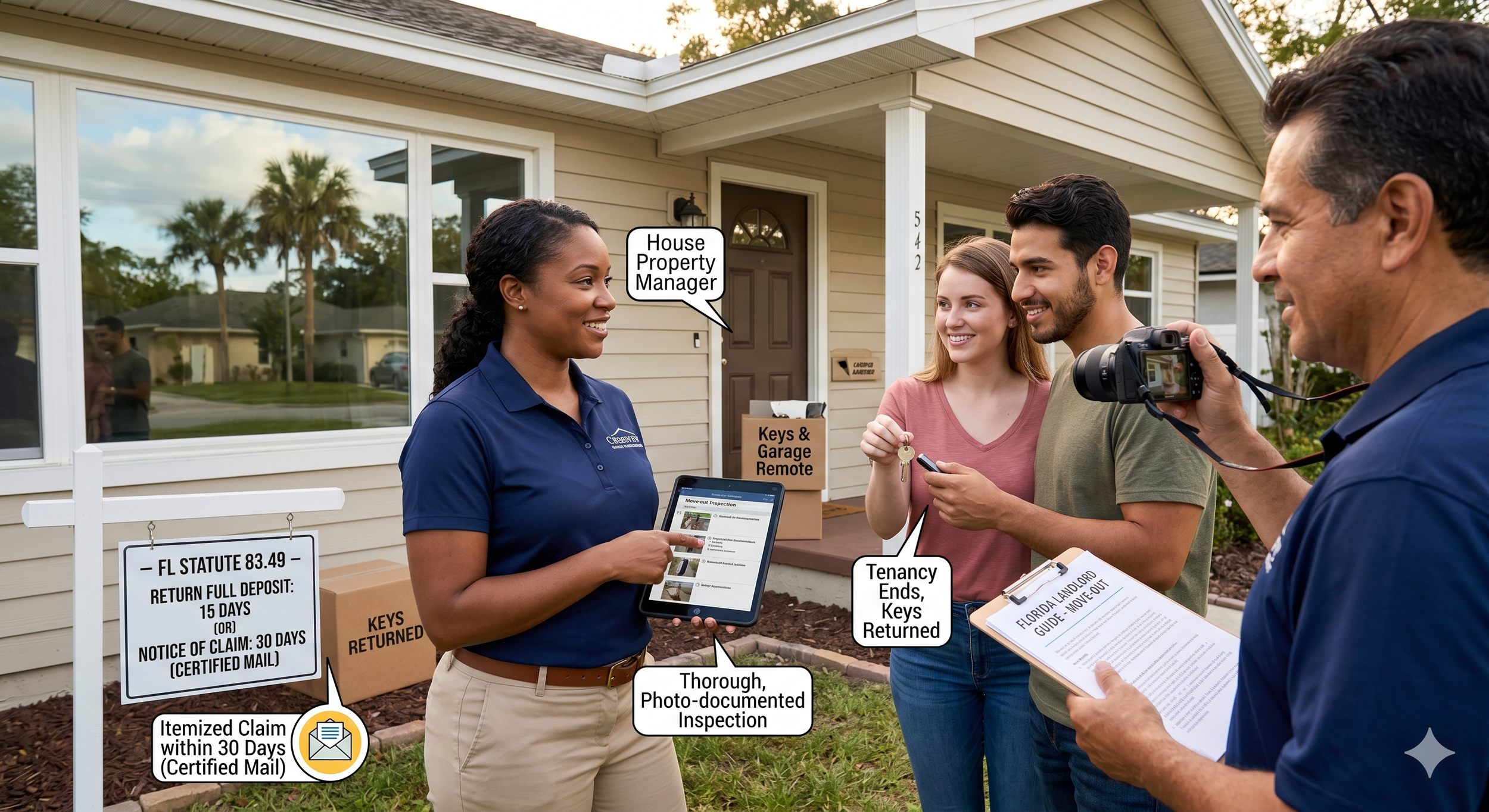
What does the move-out process look like for a Florida rental property owner, and what are the legal requirements? Florida landlords must return the full security deposit within 15 days of move-out if no deductions are made, or send a written itemized claim by certified mail within 30 days if deductions are intended. The move-out process also involves a thorough inspection, documentation, coordination of turnover repairs, and preparing the property to re-lease — all of which directly affect your cash flow and legal exposure.
The moment a tenant gives notice — or their lease term ends — the clock starts on a series of tasks that need to happen in the right order, on the right timeline, with the right documentation. Miss a step and you lose your right to make a deposit claim. Rush the turnover and you end up with a substandard property that sits vacant longer or attracts lower-quality applicants. Do it well and you're back on market quickly, protected legally, and positioned for the next tenancy.
Here's exactly how a professional move-out process should work in Florida.
Step 1: Confirm the Move-Out Date and Notice Requirements
Before anything else, confirm when the tenancy is actually ending and verify that the proper notice was given.
For a fixed-term lease, the tenancy ends on the date specified in the lease — no additional notice is required from either party unless the lease terms provide otherwise. However, if a tenant gives notice that they intend to vacate before the lease end date, this is an early termination that may have financial implications depending on the lease terms.
For month-to-month tenancies, Florida law requires at least 30 days' written notice from either party to terminate the tenancy. As of 2025, Florida updated this requirement from 15 days to 30 days — a change worth knowing if you manage any month-to-month arrangements.
Confirm the exact move-out date in writing. This date triggers the legal timelines for security deposit handling, and any ambiguity about when the tenancy actually ended creates problems later.
Step 2: The Move-Out Inspection
The move-out inspection is the foundation of the entire post-tenancy process. Everything that follows — deposit claims, turnover repair decisions, documentation for your records — flows from a thorough, well-documented inspection.
The inspection should be conducted as close to the move-out date as possible, ideally on the day the tenant returns possession of the property and the keys. Go room by room. Document everything with photos and written notes — walls, flooring, fixtures, appliances, windows, doors, exterior.
Compare what you find against the move-in condition report from the beginning of the tenancy. This comparison is what determines legitimate deductions. Without a thorough move-in baseline, any damage you observe at move-out becomes he-said-she-said — and Florida courts tend to give the benefit of the doubt to tenants when documentation is thin.
In CrossView Property Management's standard process, four scheduled inspections occur across every tenancy — at move-in, approximately three months post-move-in, at lease renewal, and at move-out. Each is documented with photos uploaded to the owner portal. This ongoing documentation trail makes the move-out comparison clear and defensible.
If a tenant requests to be present during the move-out inspection, accommodating that request is generally good practice — it reduces the chance of a disputed claim later by giving the tenant an opportunity to see the condition of the property at the time of inspection.
Step 3: Assess What's Deductible vs. Normal Wear and Tear
Before making any deposit claim, you need to honestly assess what you can legally deduct and what counts as normal wear and tear.
Florida law prohibits deductions for normal wear and tear — deterioration that occurs naturally through ordinary use of the property over time. Faded paint from sun exposure, small nail holes from picture hanging, gently worn carpet in high-traffic areas, loose door handles, minor scuffs on baseboards — these are not deductible.
What is deductible: damage beyond normal wear and tear, unpaid rent, cleaning costs to restore the property to its original condition, replacement of items the tenant damaged or removed, and costs to repair specific damage caused by the tenant's negligence or misuse.
The most common areas of dispute: carpet (worn vs. stained or burned), paint (faded vs. damaged or unauthorized color changes), and walls (small nail holes vs. large damage). The longer a tenancy, the more normal wear and tear accumulates — and a judge reviewing a claim against a three-year tenancy will apply a different standard than one reviewing a claim against a twelve-month tenancy.
Get actual contractor or vendor quotes for any legitimate repair items before finalizing your claim amounts. Itemized claims with specific dollar amounts are required — you can't just claim a lump sum "for damages." Each item needs its own line and amount.
Step 4: Handle the Security Deposit on the Right Timeline
This is where the financial exposure lives. Florida's deposit return and claim timelines are strict and the consequences of missing them are severe.
If you're returning the full deposit: You must return it within 15 days of the tenant vacating and surrendering possession. No exceptions.
If you intend to make any deductions: You must send a written notice to the tenant's last known address by certified mail within 30 days of the tenant vacating. The notice must itemize each specific deduction with a dollar amount. If you miss the 30-day window, you forfeit your right to make any claim — regardless of how legitimate the damage was or how well you documented it.
After the tenant receives your claim notice: The tenant has 15 days to object in writing. If they don't object within 15 days, you can deduct the stated amounts and return the remainder. If they do object, the dispute may need to be resolved through negotiation or in court.
One important update: Florida law now allows notices (including deposit claim notices) to be delivered electronically — by email — if both parties agreed to electronic notice in the lease agreement or a written addendum. This flexibility helps with timely delivery, but if email is returned as undeliverable, the notice must be re-served through a traditional method. Always keep proof of transmission.
Step 5: Coordinate Turnover Repairs and Cleaning
Once the inspection is complete and the deposit handled, the focus shifts to getting the property back in rentable condition as quickly as possible. Every day the property sits vacant is direct lost income.
Prioritize repairs in order of impact on leasing speed and condition. HVAC service should be on the list regardless of season — service between tenancies is standard practice. Deep professional cleaning comes before any paint or cosmetic work. Painting is faster and looks better over a clean surface.
If flooring replacement is needed, this is typically the longest-lead item — order materials promptly, schedule installation, and keep the rest of the turnover moving in parallel where possible.
Document all turnover work — vendor invoices, before/after photos — both for your financial records and as supporting documentation if the former tenant disputes any deposit claim after the fact.
Step 6: Update Your Insurance and HOA (If Applicable)
A vacancy period — even a short one — is a moment to confirm your landlord insurance policy is current and that the property is covered during turnover. Some policies have specific provisions for vacancy periods.
If your property is in an HOA community, confirm whether there are any requirements for lease handovers, tenant registration processes for new tenants, or transfer fees due at the start of the new tenancy.
Step 7: Re-Lease the Property
With the property clean, repaired, and documented, the focus turns to getting it back on market. A well-prepared turnover should be ready for professional photography and listing within a reasonable window after the prior tenant vacates.
Pricing should be based on current comparable rental activity — not what you charged last year, not what you'd like to receive, but what the market supports today. CrossView provides a current market analysis for every property at re-leasing to ensure pricing reflects actual market conditions across Jacksonville, Orange Park, Fleming Island, Nocatee, St. Augustine, and the rest of Northeast Florida.
The move-out process is where professional property management earns its value most visibly. A managed move-out means thorough documentation from move-in through move-out, legally compliant deposit handling, coordinated turnover repairs through an established vendor network, and a re-leasing process that minimizes vacancy time. If you're self-managing and this process feels like a lot to coordinate — it is. Reach out for a free consultation.
CrossView Property Management 📞 904-855-7933 ✉️ rentals@crossviewpm.com www.crossviewpropertymanagement.com
Frequently Asked Questions
Q: How long does a Florida landlord have to return the security deposit after move-out? A: If no deductions are being made, Florida law requires the full deposit to be returned within 15 days of the tenant vacating and surrendering possession. If deductions are intended, a written itemized claim must be sent by certified mail to the tenant's last known address within 30 days. Missing the 30-day deadline forfeits the landlord's right to make any deduction — regardless of the actual damage or how well it's documented.
Q: Can I charge a tenant for painting when they move out in Florida? A: Only if the condition of the walls goes beyond normal wear and tear. Routine repainting to keep a unit in rentable condition is considered standard maintenance and is not deductible from the security deposit. Faded paint from sunlight or minor scuffs from everyday living are normal wear and tear. Walls that are significantly damaged, marked with unauthorized colors, or left in a condition that requires more than routine touch-up may support a partial deduction. Get specific vendor quotes and document carefully before making a claim.
Q: What is the move-out inspection process for a Florida rental property? A: Conduct the move-out inspection as close to the move-out date as possible — ideally the day the tenant returns possession. Go room by room, document everything with photos, and compare conditions against the move-in condition report. This baseline comparison is what determines legitimate deposit deductions. Without a thorough move-in baseline, deposit claims become difficult to defend. CrossView Property Management conducts documented inspections at four points across every tenancy, creating a clear comparison record.
Q: What can a Florida landlord deduct from a security deposit at move-out? A: Allowable deductions include unpaid rent, damage beyond normal wear and tear, excessive cleaning costs, and replacement of fixtures or items the tenant damaged or removed. Normal wear and tear — faded paint, small nail holes, gently worn carpet, loose door handles — is not deductible. Each deduction must be itemized with a specific dollar amount in the written claim notice. Get vendor quotes to support each item before finalizing the claim.
Q: How do I minimize vacancy time between tenants in Jacksonville, FL? A: Start the move-out inspection on the day of move-out, handle the deposit within the legal timeline, and prioritize turnover repairs in order of leasing impact — cleaning first, then paint, then other cosmetic work. Have professional photos scheduled as soon as the property is ready and price based on current market comparables, not prior-year rates. CrossView Property Management coordinates the full turnover process for managed properties across Jacksonville and Northeast Florida, with vendor relationships that allow for efficient scheduling and faster re-leasing. Call 904-855-7933 or email rentals@crossviewpm.com.