How to Get Your Home Rent-Ready in Jacksonville, FL
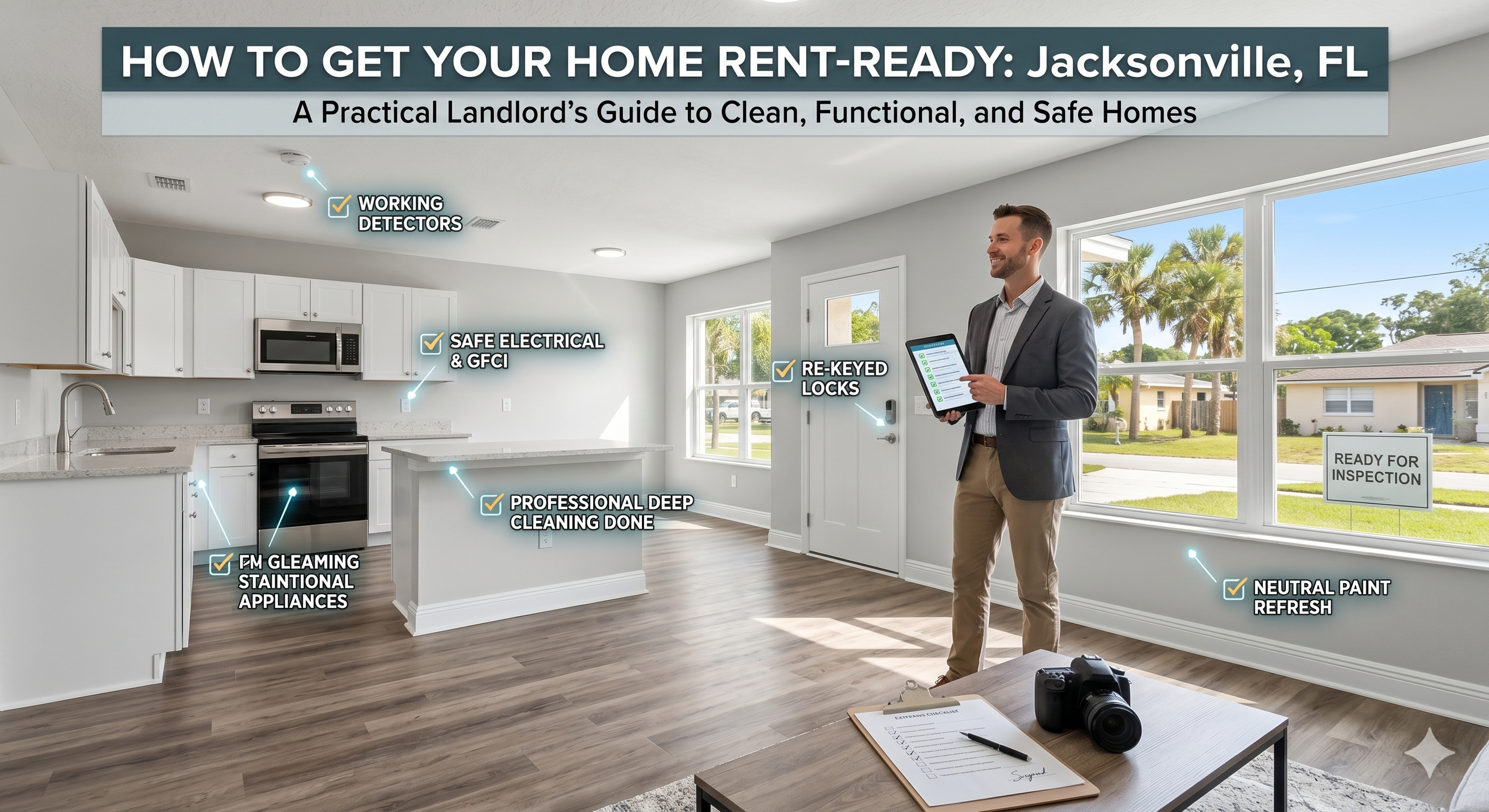
What does it mean to get your home rent-ready in Florida, and what actually needs to be done? A rent-ready home is clean, functional, safe, and presented in a condition that attracts qualified tenants and supports a strong rental rate. In Jacksonville and across Northeast Florida, that means addressing maintenance, deep cleaning, safety systems, and documentation — before the first showing, not after.
The condition of your property at the time of listing does more work than most landlords realize. It affects how quickly you lease, what you can charge, and the quality of tenant you attract. A well-presented, move-in-ready home signals to an applicant that the landlord is professional and that the property is well-maintained — and that signal tends to attract tenants who bring the same attitude to how they'll treat it.
Here's a practical, Florida-specific guide to what getting your home rent-ready actually involves — and what you don't need to spend money on.
Start With a Complete Walkthrough
Before you spend a dollar on anything, walk the property with fresh eyes. Not as a homeowner who knows where the quirks are, but as a prospective tenant seeing it for the first time.
Go room by room and note anything that's broken, worn, missing, or visually off. Check every outlet and light switch. Run every faucet. Test every appliance. Open every cabinet door and closet. Flush every toilet. Turn on the HVAC and confirm it's functioning. Look at the walls, the floors, the ceilings. Go outside and look at the yard, the driveway, the exterior paint and trim, and any visible roofline.
Take photos as you go — not to share with anyone, but to document the property's current condition before any work starts. This baseline documentation matters later when you're doing move-in inspection photos.
Write everything down. Prioritize into three categories: must fix before leasing, should fix before leasing, and nice to have if budget allows.
Must-Fix Items Before Leasing
These are the non-negotiables — items that affect habitability, safety, or legal compliance. A property with any of these issues outstanding is not ready to show, and a Florida landlord has a legal obligation to provide habitable housing.
HVAC. In Jacksonville's climate, a functioning air conditioning system isn't a comfort feature — it's a habitability requirement. Have the system serviced before the property goes on the market. Replace the filter, have the unit inspected, and confirm it's cooling properly. An HVAC failure in the first 30 days of a tenancy creates a maintenance emergency, a liability issue, and a bad first impression that's hard to recover from.
Plumbing. Fix all leaks — under sinks, at fixtures, in the water heater connections. Check water pressure. Confirm all drains are clear. A dripping faucet or a slow drain that you've ignored for months becomes a maintenance ticket the first week.
Electrical. All outlets should be functional. GFCI outlets should be installed and tested in kitchens, bathrooms, garages, and exterior locations — Florida building code requires them, and a non-functional GFCI is a safety issue. Replace any broken switch covers or outlet plates.
Smoke and carbon monoxide detectors. Test every detector. Replace batteries or the units themselves as needed. Florida law requires working smoke detectors, and it's one of the most basic safety obligations a landlord has.
Re-key the locks. Every tenant deserves to know they're the only person with a key to their home. Re-key all exterior door locks before move-in — this is standard practice and one of the simplest ways to start a tenancy on the right foot.
Mold and moisture. Florida's heat and humidity make this a more urgent issue than in most other states. Check bathrooms, laundry areas, under sinks, and any area with a history of water intrusion. Visible mold is a habitability issue and a potential Fair Housing liability. Address it before the property goes on the market.
Appliances. If appliances are being included in the lease, they need to be fully functional. A broken dishwasher, a stove burner that doesn't light, or a refrigerator that doesn't hold temperature should be repaired or replaced before move-in — not promised to be fixed later.
Deep Cleaning: Non-Negotiable
A property that hasn't been professionally cleaned before showing will cost you more in extended vacancy than the cleaning cost. Period.
Professional cleaning for a rental property means more than a standard house clean. It means scrubbing grout, degreasing kitchen appliances inside and out, cleaning inside cabinets and drawers, washing windows and window tracks, cleaning ceiling fans, scrubbing bathroom tile and fixtures, and leaving the property in a condition you could confidently describe as spotless.
Why does this matter so much? Because when CrossView Property Management places a tenant into a professionally cleaned property, we can charge against the security deposit at move-out if the tenant leaves it in lesser condition. If the property wasn't professionally cleaned at move-in, that claim becomes much harder to make and defend.
If the previous occupant had pets — especially dogs or cats — professional carpet cleaning or replacement may be necessary depending on condition. Pet odor that isn't fully eliminated before move-in is one of the most common complaints from incoming tenants and one of the most difficult things to remedy mid-tenancy.
Paint: When to Repaint and When to Spot-Treat
Fresh interior paint is one of the highest-impact, lowest-cost improvements you can make to a rental property. It makes a home feel new, photographs well, and signals a well-maintained property.
That said, a full repaint isn't always necessary. If the walls are in decent condition with only minor scuffs, professional spot-treating and touch-ups may be sufficient. If walls are noticeably marked, stained, or showing significant wear — or if the current color is unusual or very dark — a full repaint in a neutral, tenant-friendly color (light gray, warm white, or soft beige) is worth the investment.
What you should not do: repaint over dirt, stains, or water damage without addressing the underlying issue first. Painting over mold or water stains doesn't fix the problem — it just delays it and creates a more expensive repair later.
One note specific to Florida: use interior paint rated for humidity. Flat paint in high-moisture areas like bathrooms without proper ventilation degrades quickly. Semi-gloss or satin finishes in bathrooms, kitchens, and utility spaces hold up better and clean more easily.
What Not to Over-Invest In
This section is as important as the rest. A lot of first-time landlords over-improve their rental property — spending money on upgrades that don't meaningfully increase rent or attract better tenants — and then wonder why the ROI doesn't pencil out.
Don't replace things that still work. If the kitchen appliances are functional and presentable, they don't need to be replaced with new ones because you'd personally prefer stainless steel. Functional beats aesthetic in a rental — especially when the improvement cost won't be recovered in higher rent.
Don't upgrade flooring unnecessarily. If carpet is clean and in reasonable condition, professional cleaning is almost always more cost-effective than replacement. If flooring genuinely needs to be replaced, consider LVP (luxury vinyl plank) — it's durable, easy to clean, and cost-effective for rental use.
Don't renovate kitchens or bathrooms speculatively. A kitchen remodel that costs $15,000 might add $50 to monthly rent in your area. That's a 25-year payback. Paint the cabinets, replace hardware, and make sure everything is clean and functional — that's usually enough.
Don't landscape beyond basic curb appeal. A clean, mowed yard with trimmed hedges and no visible weeds is the target. An elaborately landscaped yard is a maintenance liability you'll eventually have to address when the tenant doesn't maintain it.
Update Your Insurance Before You List
This one isn't optional and often gets forgotten. A standard homeowner's insurance policy typically doesn't cover a tenant-occupied property. Before your first tenant moves in, contact your insurer to convert to a landlord policy — also called a dwelling fire policy or rental property insurance. This covers property damage, liability as a landlord, and loss of rental income in some cases.
Requiring tenants to carry their own renters insurance is also smart practice and is built into CrossView's standard lease. It protects the tenant's personal property and provides liability coverage that can reduce claims against your policy.
HOA Requirements
If your property is in a homeowners association — and many Jacksonville area communities are — review the HOA's rental rules before you list. Some communities require prior approval of tenants, have minimum lease term requirements, or have rules about who can occupy the property. Getting a tenant signed and then discovering an HOA restriction is one of the more stressful situations a landlord can face.
CrossView handles HOA coordination as part of our standard management process, including property cleanup compliance for any violations that arise during a tenancy.
Getting Ready Is Where We Start Together
When a new owner comes to CrossView Property Management, the first conversation is always about the current state of the property and what it needs before we list. We'll walk through it with you — either in person or through photos — and give you a clear, honest picture of what's necessary, what's optional, and what will have the most impact on your rental rate and tenant quality.
We serve property owners across Duval, Clay, and St. Johns counties, including Jacksonville, Orange Park, Fleming Island, Middleburg, Green Cove Springs, St. Augustine, Ponte Vedra Beach, St. Johns, and Nocatee. If you're getting your home ready to rent and want professional guidance on next steps, reach out.
CrossView Property Management 📞 904-855-7933 ✉️ rentals@crossviewpm.com www.crossviewpropertymanagement.com
Frequently Asked Questions
Q: What does rent-ready mean for a rental property in Florida? A: A rent-ready property is clean, fully functional, safe, and presented in a condition that attracts qualified tenants without requiring them to overlook obvious issues. In Florida specifically, rent-ready means a functioning HVAC system, all plumbing and electrical working properly, smoke detectors tested and operational, deep professional cleaning completed, and all appliances included in the lease in working order. It also means the property has been photographed and documented for the move-in condition report.
Q: How much does it cost to get a home rent-ready in Jacksonville, FL? A: It varies significantly by property condition. A home that just needs professional cleaning, minor repairs, and re-keyed locks might cost $500 to $1,500 to prepare. A home that needs fresh paint, appliance repairs, HVAC service, and carpet cleaning could run $3,000 to $6,000 or more. The key is not over-investing in upgrades that won't be recovered through higher rent — focus on condition, cleanliness, and functionality rather than renovation.
Q: Do I need to repaint my rental property before a tenant moves in? A: Not necessarily. If walls are in decent condition with only minor scuffs, professional spot-treating may be sufficient. If walls are significantly marked, stained, or showing notable wear — or if the color is unusual or very dark — a full repaint in a neutral color is worth the investment. Fresh paint dramatically improves how a property photographs and presents, which directly affects leasing speed and tenant quality.
Q: What are the most important things to fix before renting my home in Florida? A: HVAC functionality is first — in Florida's climate, it's a habitability requirement, not a comfort feature. After that, plumbing leaks, electrical issues, non-functional appliances, smoke and CO detectors, and any moisture or mold concerns should all be addressed before listing. These aren't optional — they're both legal obligations and practical necessities for attracting and retaining a quality tenant.
Q: Does CrossView help landlords get their property rent-ready in Jacksonville? A: Yes. When a new owner comes to CrossView, we review the property's current condition and provide honest guidance on what needs to be done before listing — and what's not necessary. We coordinate vendor work through our established contractor network across Duval, Clay, and St. Johns counties, and we don't mark up those costs. Call 904-855-7933 or email rentals@crossviewpm.com to get started.