Landlord vs. Property Management Company: What's the Difference?
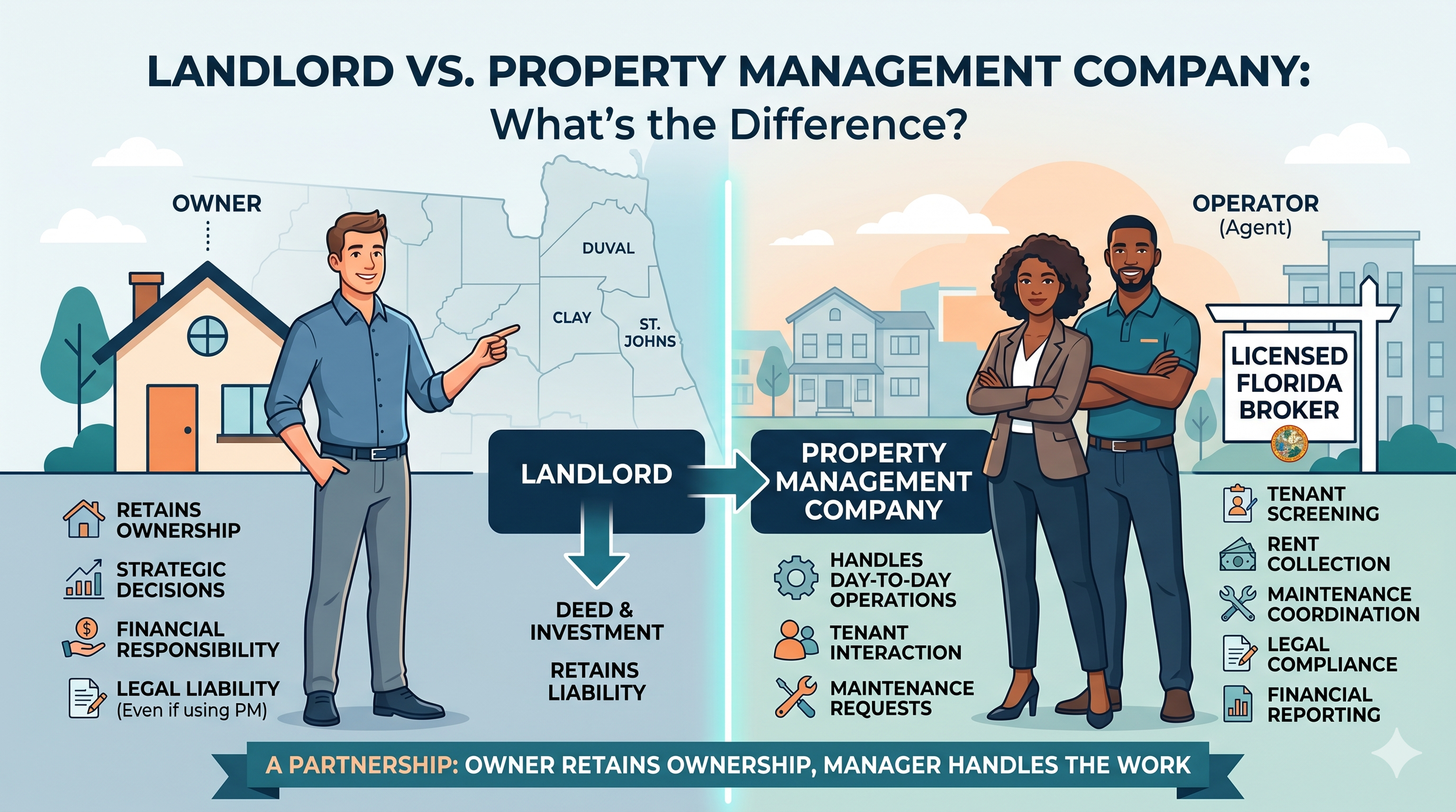
What is the difference between a landlord and a property management company? A landlord is the person who owns the rental property. A property management company is hired by the landlord to handle the day-to-day operations — tenant screening, rent collection, maintenance, legal compliance, and more. The landlord always retains ownership; the property manager handles the work.
If you're new to renting out a home, these two terms can blur together fast. And honestly, that's understandable — because in some situations, one person fills both roles. But knowing exactly where the line is helps you make a much better decision about how you want to manage your investment.
Here's how it actually breaks down.
What Is a Landlord?
A landlord is simply the owner of a rental property. That's it. The title comes with the deed, not with any particular set of tasks.
What a landlord chooses to take on is a different question. Some landlords manage everything themselves — they find tenants, collect rent, field maintenance calls, and handle every legal notice that needs to go out. Others hand all of that off to a professional and stay almost entirely in the background.
Both are valid approaches. But both come with tradeoffs.
One thing that doesn't change regardless of which path you choose: the landlord carries the financial and legal responsibility for the property. If something goes wrong — a Fair Housing complaint, a habitability issue, a security deposit dispute — it's the owner's name on the line. A property management company acts on your behalf, but it doesn't absorb your liability.
What Is a Property Management Company?
A property management company is a licensed, professional firm hired to operate a rental property on behalf of the owner. In Florida, any company or individual managing rental properties for others and collecting compensation must hold an active real estate broker's license — that's a legal requirement under Florida law, not just an industry standard.
Worth noting: if you own the property and manage it yourself, no license is required. But the moment you hire someone to manage it for you on a commission basis, that person or company needs to be properly licensed. Before you sign with any property manager in Jacksonville or anywhere else in Northeast Florida, it's worth verifying their license through the Florida Department of Business and Professional Regulation.
A property management company typically handles:
Tenant marketing and advertising — getting the property in front of qualified prospective renters
Tenant screening — background checks, credit reports, income verification, eviction history, rental references
Lease preparation — drafting legally compliant leases that hold up under Florida law
Rent collection — including handling late payments and issuing proper notices
Maintenance coordination — fielding requests, dispatching vendors, overseeing repairs
Legal compliance — proper notice procedures, security deposit handling, eviction management
Financial reporting — keeping the owner informed on income, expenses, and property performance
Move-in and move-out documentation — protecting the owner's ability to make legitimate security deposit claims
In short, the property management company does the work. The landlord makes the strategic decisions — whether to rent, what major improvements to make, when to sell — and receives the financial benefit.
The Self-Managing Landlord: What You're Actually Signing Up For
Choosing to self-manage means you're taking on every one of those responsibilities listed above. For some landlords, that works well. If you're local, experienced, have reliable contractors, and genuinely have the time to be responsive, self-management is a viable path.
But it's worth being honest about what "responsive" means in practice. Maintenance requests don't arrive at convenient times. Tenant issues — lease disputes, late rent, noise complaints — require prompt, documented responses. The eviction process in Florida has strict procedural requirements, and one misstep can send you back to square one while the tenant remains in your property.
There's also the tenant screening piece. Self-managing landlords often lack access to the same professional screening tools that property management companies use. And unfortunately, some prospective tenants with eviction history or unverifiable income specifically seek out self-managing landlords — in Jacksonville and across Northeast Florida — because they know the vetting is less rigorous. It's a real pattern that costs real landlords real money.
The Property Management Route: What You Gain (and What It Costs)
Working with a professional property management company means giving up some day-to-day control in exchange for expertise, systems, and time. For most landlords — especially those who are new, out of town, or managing multiple properties — that's a trade worth making.
What you gain: professional tenant screening, legally compliant processes, faster maintenance response through established contractor networks, and a buffer between you and the emotional weight of tenant disputes. Professional managers also stay current on Florida landlord-tenant law, which changes and carries real consequences when ignored.
What it costs: typically between 8% and 12% of monthly rent for a full-service property management company in the Jacksonville area. On a $2,000/month rental, that's $160 to $240 per month.
What that fee actually buys you: one bad tenant placement, one botched eviction, one mishandled security deposit — any of those wipes out a full year of management fees and then some. The math on professional management is often better than it looks on the surface.
So Which One Are You — and Which Should You Be?
Every landlord starts with the same question: do I manage this myself or hire someone?
The honest answer depends on your experience level, how much time you have, how close you are to the property, and how much risk you're comfortable carrying. There's no universal right answer — but there is an honest one for your specific situation.
At CrossView Property Management, we work with property owners across Duval, Clay, and St. Johns counties — in Jacksonville, Orange Park, Fleming Island, Middleburg, Green Cove Springs, St. Augustine, Ponte Vedra Beach, St. Johns, and Nocatee. Some come to us from day one. Some come to us after a difficult self-managing experience. Either way, we're happy to have a straight conversation about what makes sense for your property.
If you're weighing your options, start with a free consultation. No pressure — just honest guidance.
CrossView Property Management 📞 904-855-7933 ✉️ rentals@crossviewpm.com www.crossviewpropertymanagement.com
Frequently Asked Questions
Q: What is the difference between a landlord and a property manager in Florida? A: A landlord is the owner of the rental property and carries the ultimate financial and legal responsibility for it. A property manager — or property management company — is hired to handle daily operations on the landlord's behalf, including tenant screening, rent collection, maintenance, and legal compliance. In Florida, property managers who work for compensation must hold a real estate broker's license. Landlords who self-manage their own properties are exempt from that requirement.
Q: Can a landlord in Florida manage their own rental property without a license? A: Yes. Florida law does not require a license to manage a property you personally own. The licensing requirement applies to individuals or companies managing properties on behalf of other owners and collecting compensation for doing so. If you own the rental and manage it yourself, you can do so without a real estate license — though you're still responsible for full compliance with Florida's landlord-tenant laws.
Q: What does a property management company do that a landlord doesn't have to? A: A property management company handles the operational side of renting — tenant marketing and screening, lease preparation, rent collection, maintenance coordination, legal notices, move-in and move-out documentation, and financial reporting. This frees the landlord from day-to-day involvement while keeping the property professionally managed and legally compliant. The landlord retains ownership and makes major decisions; the property manager handles the execution.
Q: How much does a property management company cost in Jacksonville, FL? A: Most full-service property management companies in the Jacksonville area charge between 8% and 12% of monthly rent. On a $2,000/month rental, that's roughly $160 to $240 per month. When weighed against the cost of a bad tenant placement, a procedural eviction error, or a security deposit dispute, professional management often pays for itself — sometimes within a single incident.
Q: Do I need a property manager if I only own one rental property in Jacksonville? A: Not necessarily — but it depends on your situation. A single-property landlord who is local, experienced, and has the time to manage actively may do just fine self-managing. That said, single-property owners are just as exposed to legal risk, bad tenant placements, and maintenance challenges as anyone with a larger portfolio. CrossView Property Management works with single-property owners across Jacksonville, Orange Park, St. Augustine, and the surrounding Northeast Florida area and is happy to walk through what professional management would look like for your specific property. Call 904-855-7933 or email rentals@crossviewpm.com to start the conversation.