The Jacksonville FL Rental Market in 2026: What Property Owners Need to Know
What is the Jacksonville FL rental market doing in 2026 — and what should rental property owners be doing about it?
After a turbulent few years defined by pandemic-era rent spikes, a wave of new apartment construction, and a softening correction through 2024 and into 2025, Jacksonville's rental market is finding its footing again. Rents have stabilized, vacancy rates are settling at healthy levels, and population growth continues to fuel steady demand. For property owners who understand what's happening — and act accordingly — this is a strong market. For those who don't, it's an easy one to misread.
Where the Jacksonville Rental Market Stands Right Now
The story of the past two years in Jacksonville has been one of correction after a historic run-up. Rents surged dramatically during 2021 and 2022, then pulled back as a significant wave of new apartment inventory hit the market. That oversupply created downward pressure on rents and pushed apartment operators to offer concessions — free rent, waived fees, discounted first months — just to keep units filled.
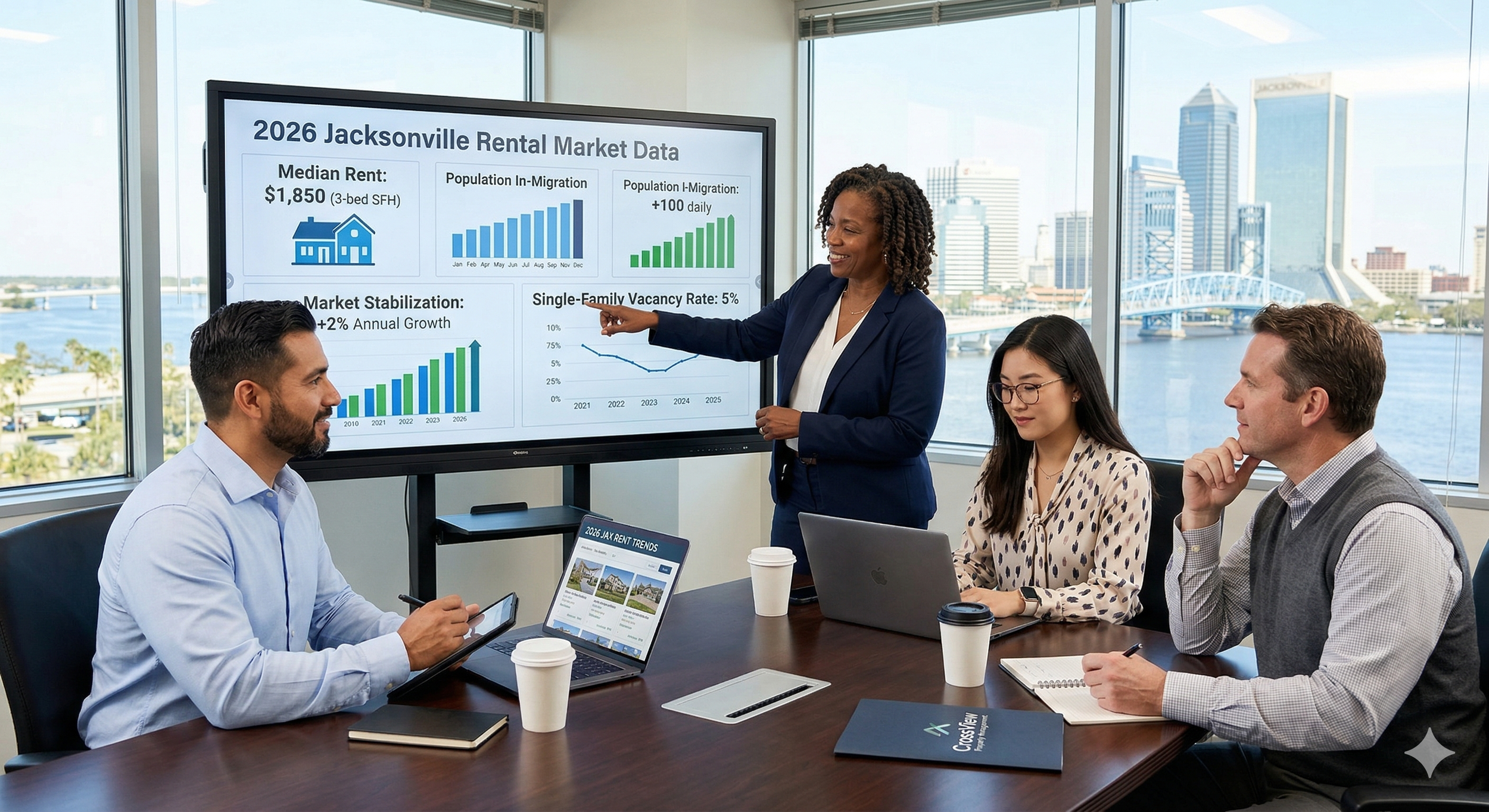
That pressure is easing. Single-family rental vacancy rates across the Jacksonville metro are now hovering around 5%, a historically healthy range. Rent growth has returned, though modestly — the market is trending in the 1% to 2% annual growth range rather than the double-digit swings owners got used to during the frenzy. Average rents for a single-family home in Jacksonville are generally landing between $1,775 and $1,900 per month for a standard three-bedroom, with variation depending on location, condition, and how well the property is positioned.
The key shift: the correction is largely behind us. This is a stabilization story, not a decline story.
Population Growth Is Still Doing the Heavy Lifting
What makes the Jacksonville FL rental market fundamentally different from markets seeing steeper corrections elsewhere in Florida is the demand side of the equation. Jacksonville continues to add population at a pace that most cities would envy — with projections pointing to over 100 new residents arriving in the metro area daily. That kind of sustained in-migration creates a consistent floor of rental demand that prevents the deeper corrections playing out in markets like Cape Coral or Fort Myers.
Northeast Florida as a whole — Duval, St. Johns, and Clay counties included — continues to benefit from that growth engine. St. Johns County remains one of the fastest-growing counties in the state. Communities like Nocatee, Ponte Vedra Beach, and St. Johns are seeing sustained demand from relocating households who aren't yet ready to buy in a high-rate environment. That translates directly to qualified rental applicants for well-maintained properties in those areas.
What This Market Means for Single-Family Rental Owners
The apartment sector and the single-family rental sector are telling different stories right now, and owners of single-family homes in Jacksonville should understand the distinction. While apartment operators are still burning through concession budgets to compete with one another, single-family rental demand is holding steady. Renters who want a yard, a garage, and a neighborhood — not a complex — have far fewer options than they did two or three years ago, and that inventory gap works in your favor.
That said, the days of renting anything at any price are over. Properties that are clean, updated, and priced correctly are leasing well. Properties that are dated, deferred on maintenance, or overpriced relative to comparable homes in the area are sitting — and sitting longer than owners expect. The market is rewarding preparation and penalizing complacency, which is exactly the kind of environment where professional property management earns its keep.
Heading Into Peak Leasing Season
Spring and summer are historically the strongest leasing months in the Jacksonville market, and 2026 is shaping up to follow that pattern. If you have a property coming available — or a lease renewal approaching — the window between now and August is when you want to be active. Waiting until fall to list a vacancy means competing for a smaller pool of applicants in a slower season.
Now is the time to assess your property's condition, confirm your rental rate is aligned with current comps, and make sure your marketing and screening process is ready to move quickly when the right applicant comes through.
At CrossView Property Management, we work with rental property owners across Jacksonville, Orange Park, Fleming Island, Middleburg, Green Cove Springs, Ponte Vedra Beach, and throughout St. Johns and Clay counties. We watch this market every day — and we help owners make smart decisions based on what's actually happening, not what happened two years ago.
If you want a clear picture of what your property should rent for in today's Jacksonville FL rental market, reach out to CrossView Property Management for a free rental analysis.
Frequently Asked Questions
Q: What is the average rent for a single-family home in the Jacksonville FL rental market in 2026? A: For a standard three-bedroom single-family home in the Jacksonville metro, average rents are generally running between $1,775 and $1,900 per month in 2026. Rents vary meaningfully by location, condition, and property type — homes in St. Johns County and the Ponte Vedra Beach corridor typically command a premium over comparable properties in other parts of the metro.
Q: Are rents going up or down in Jacksonville FL in 2026? A: After softening through 2024 and into 2025 due to an oversupply of new apartment inventory, Jacksonville rents have largely stabilized heading into 2026. Modest growth in the 1% to 2% range is the current trend — a return to pre-pandemic norms rather than the sharp swings of recent years.
Q: Is now a good time to rent out a property in Jacksonville FL? A: Yes, particularly for single-family rental owners. Vacancy rates are sitting at healthy levels around 5%, population growth continues to drive consistent demand, and peak leasing season runs through spring and summer. Properties that are well-maintained and correctly priced are leasing at a solid pace.
Q: How does Jacksonville's rental market compare to the rest of Florida in 2026? A: Jacksonville is holding up better than several other Florida metros. Markets like Cape Coral and Fort Myers are seeing more significant corrections, while Jacksonville benefits from continued strong population growth and a more diversified economy. Sustained in-migration from other states continues to provide a foundation of rental demand that supports the market.
Q: What should a Jacksonville rental property owner do to prepare for peak leasing season in 2026? A: Start early. Assess your property's current condition, confirm your asking rent reflects today's comparable properties rather than last year's peak, and make sure your listing, screening, and application process can move quickly. The best applicants don't wait around, and spring inventory fills faster than most owners expect.