

What to Do When a Tenant Won't Leave After the Lease Ends in Florida
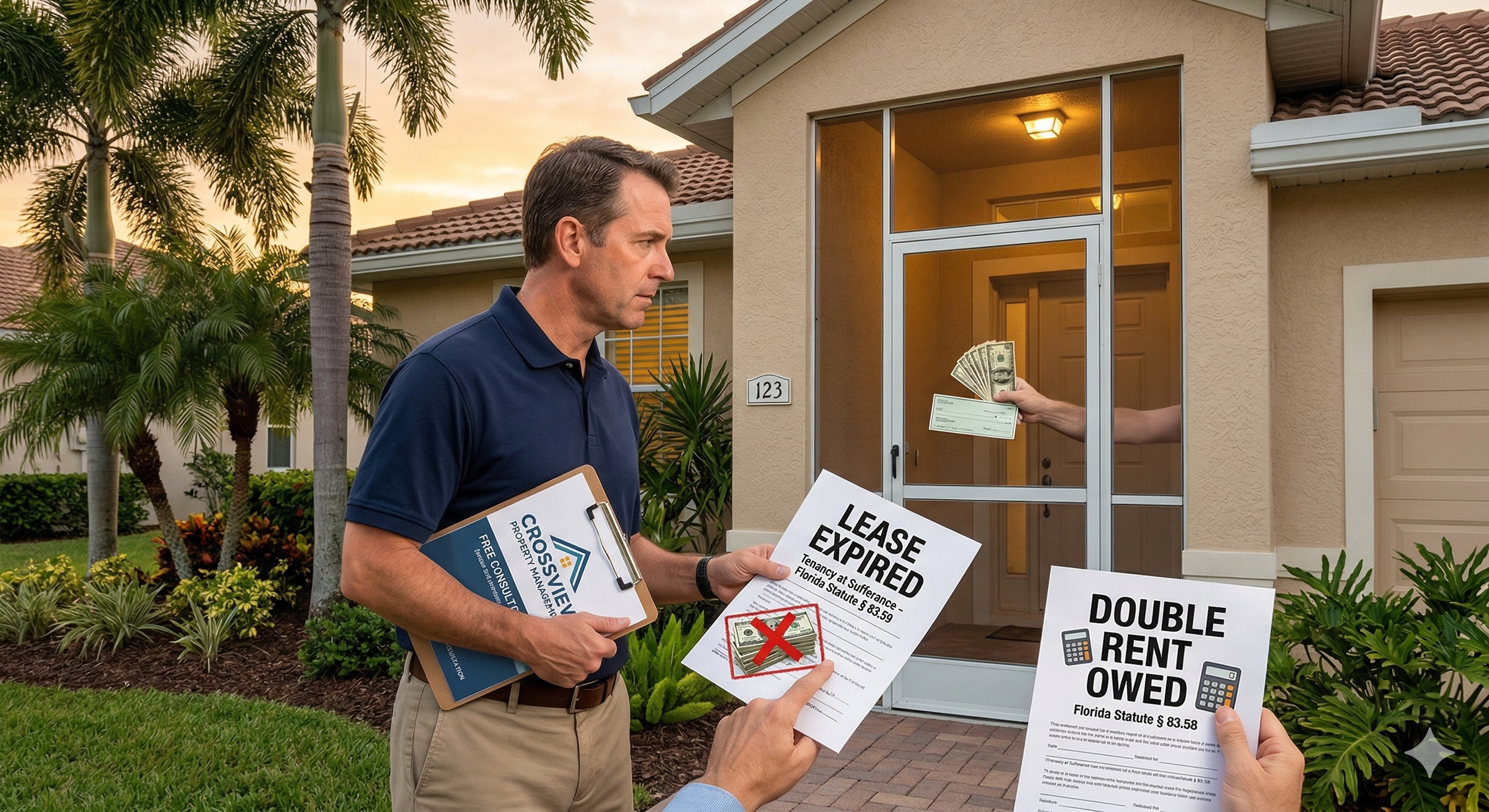
What are a landlord's rights in Florida when a tenant refuses to leave after the lease expires?
More than most owners realize. Florida law is firmly on the landlord's side in a holdover situation — including a provision that allows you to demand double the monthly rent for every day the tenant remains without permission. But those rights only hold if you handle the situation correctly from the moment the lease ends. One common mistake — accepting even a single rent payment after expiration — can accidentally hand the tenant a new month-to-month tenancy and reset the entire process. Here's what you need to know before that happens.
What Is a Holdover Tenant in Florida?
A holdover tenant is a renter who remains in possession of a property after their lease has legally expired without the landlord's permission. Under Florida law, this creates what's called a tenancy at sufferance — the tenant has no legal right to be there, but the landlord has not yet taken action to remove them.
Florida leases do not automatically renew unless the lease contract specifically says they do. When the end date arrives and the tenant stays without a new agreement in place, the lease is over. The tenant's right to occupy the property is over with it. What happens next depends entirely on what the landlord does in those first critical days.
The Mistake That Changes Everything: Accepting Rent
This is the detail that catches owners off guard more than any other. If you accept a rent payment from a tenant after their lease has expired — even one payment, even a partial one — Florida law may treat that acceptance as your consent to a new month-to-month tenancy. At that point the holdover situation transforms. The tenant now has tenancy-at-will status, the original lease terms carry forward, and you're required to provide proper notice to terminate before you can pursue eviction.
That means the clock resets. The leverage of the holdover situation disappears. And a process that could have moved quickly becomes a longer one.
If your lease has ended and the tenant hasn't left — do not accept any payment. Not a check, not a Venmo transfer, not cash handed through the door.
What Florida Law Actually Allows You to Do
Under Florida Statute § 83.58, a landlord whose tenant refuses to surrender possession after the lease ends is entitled to recover double the amount of rent for the entire period the tenant remains as a holdover. That's not a negotiating tactic — it's a statutory right. If your tenant was paying $2,000 a month and refuses to leave for 45 days, you may be entitled to pursue $3,000 for that period.
Under Florida Statute § 83.59, you're entitled to file a complaint in county court to recover possession of the property. Unlike a nonpayment eviction, a holdover eviction does not require a Three-Day Notice to Pay or Vacate. The lease has already ended. The tenant was already on notice. You can move directly to filing once the lease expiration date has passed and the tenant remains.
That said, if your lease required you to send a notice of non-renewal — many do — make sure that notice went out on time and in writing. A lease that required 30 or 60 days' notice of non-renewal and didn't receive it could complicate your timeline. Always check your specific lease terms first.
The Eviction Process for a Holdover Tenant in Jacksonville FL
Once you've confirmed the lease has properly ended, the tenant has been given any required notice, and you have not accepted payment after expiration, you can file an eviction complaint in the county court where the property is located — Duval, Clay, or St. Johns County depending on where your property sits. The complaint asks the court for possession of the property and, if you choose, a money judgment for holdover rent.
The tenant will be served and has five days to respond. If they don't, you can move for a default judgment. If they contest, the court schedules a hearing. Once judgment is entered in your favor, the court issues a Writ of Possession and the sheriff posts a 24-hour notice before executing the removal.
As with any eviction in Florida, self-help is never an option. No changing locks. No removing belongings. No shutting off utilities. The only legal path to physically removing a tenant is through the court and the sheriff — full stop.
Why Getting Ahead of This Matters
The best holdover situation is one that never becomes one. Sending a clear notice of non-renewal 60 days before lease end, confirming the tenant's move-out date in writing, and conducting a scheduled move-out walkthrough all reduce the likelihood of a tenant simply staying put. When owners — or their property managers — manage lease endings proactively, holdover situations are the exception rather than the rule.
At CrossView Property Management, we handle lease renewals, non-renewal notices, and move-out coordination for rental property owners across Jacksonville, Orange Park, Fleming Island, Middleburg, Green Cove Springs, Ponte Vedra Beach, Nocatee, and throughout St. Johns and Clay counties. When a holdover situation does arise, we know exactly how to respond — and what not to do — from day one.
If you're dealing with a tenant who won't leave after the lease ends in Florida, or you want systems in place to prevent it, reach out to CrossView Property Management for a free consultation.
Frequently Asked Questions
Q: What are my rights as a Florida landlord when a tenant won't leave after the lease ends? A: Florida law gives landlords strong rights in a holdover situation. Under Florida Statute § 83.58, you can demand double the monthly rent for every day the tenant remains without permission after the lease expires. Under § 83.59, you can file an eviction complaint in county court to recover possession — and unlike a nonpayment eviction, a holdover eviction does not require a Three-Day Notice first. The lease ending is the notice.
Q: What happens if I accept rent from a holdover tenant in Florida? A: Accepting rent after a lease expires can be one of the costliest mistakes a Florida landlord makes. Florida law may treat that payment as your consent to a new month-to-month tenancy, which gives the tenant legal standing to remain and requires you to provide proper notice before pursuing eviction. If your lease has ended and the tenant hasn't left, do not accept any payment while you decide how to proceed.
Q: Do I need to give a holdover tenant notice before filing for eviction in Florida? A: Not always. A holdover eviction in Florida does not require the same Three-Day Notice to Pay or Vacate used in nonpayment cases — the lease expiration itself serves as notice that the tenant's right to occupy has ended. However, if your specific lease required you to send a notice of non-renewal prior to expiration, that notice must have gone out on time. Check your lease terms carefully before filing.
Q: How long does it take to evict a holdover tenant in Jacksonville FL? A: The timeline for evicting a holdover tenant in Jacksonville is generally similar to other eviction types — roughly three to eight weeks from filing through the sheriff executing a Writ of Possession, depending on whether the tenant contests and court scheduling in Duval, Clay, or St. Johns County. Cases where all notices were properly handled and the tenant doesn't contest can move toward the faster end of that range.
Q: Can a Florida landlord charge double rent to a holdover tenant? A: Yes. Florida Statute § 83.58 entitles a landlord to recover double the amount of rent due for the period during which a holdover tenant refuses to surrender possession. This is a statutory right — it doesn't require a special clause in your lease. It applies from the date the lease expires through the date the tenant vacates or is removed. To pursue this, you would request it as part of your eviction complaint and money judgment.