
Florida Homestead Exemption When Renting Out Your Home: What Jacksonville Landlords Need to Know
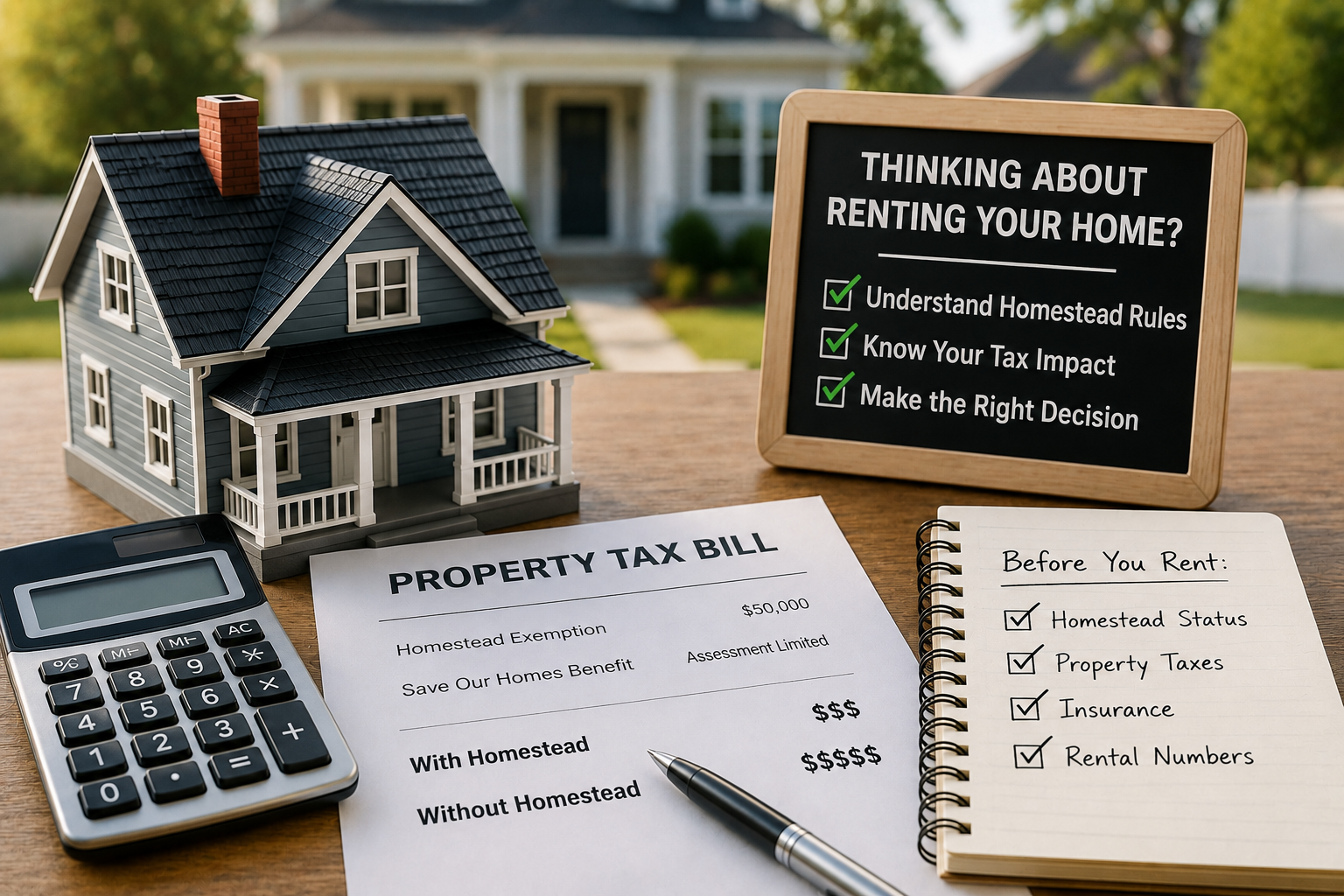
What happens to your Florida homestead exemption when you move out of your primary residence and turn it into a rental property?
Renting all or substantially all of a Florida homesteaded property can affect your homestead exemption and the Save Our Homes assessment protection that comes with it. Before you calculate whether your Jacksonville home will work as a rental, make sure you're using the property taxes you may actually pay as a landlord—not necessarily the tax bill you paid while living there.
This one catches people all the time.
You bought a home in Jacksonville.
You've lived there for several years.
Then life changes.
Maybe you're getting married. Maybe you bought another house. Maybe work is moving you. Or maybe you're military and PCS orders are taking you somewhere else.
You look at your mortgage payment, look at what the home could rent for, and think:
“I could keep this house and rent it out.”
You absolutely may be able to.
But before you run those numbers, there's one expense we really want you to look at:
Property taxes.
Because the tax bill you have while the property is your primary residence may not be the tax bill you have after it becomes a rental.
Florida Homestead Exemption and Rental Property: The Quick Version
Here's the basic picture:
| Your Situation | What You Need to Know |
|---|---|
| You own and occupy the home as your permanent residence | You may qualify for Florida homestead exemption |
| You move out and rent all or substantially all of the property | Your homestead eligibility may be affected |
| You rent the home after January 1 | Special timing rules may allow the exemption to continue for that tax year |
| The property becomes a long-term rental | Talk with your county Property Appraiser about when homestead ends |
| Homestead is removed | You can also lose the Save Our Homes homestead assessment protection |
| You're transferred on qualifying military orders | Florida law provides special protection that may allow homestead to continue |
And here's the part we don't want you to miss:
Losing homestead can mean more than simply losing the homestead exemption amount.
Let's talk about why.
What Does the Florida Homestead Exemption Actually Do?
If a Florida property is your permanent residence and you otherwise qualify, the homestead exemption can reduce the property's taxable value.
In Duval County, a qualifying owner can receive up to $50,000 in homestead exemption, although the entire amount does not apply to every type of property tax.
That's helpful.
But the exemption itself is only part of the benefit.
Homestead also brings something called Save Our Homes.
And that can be a much bigger deal over time.
The Bigger Issue May Be Losing Your Save Our Homes Benefit
Florida's Save Our Homes provision limits how quickly the assessed value of qualifying homesteaded property can increase from year to year.
So let's say you bought your Jacksonville house years ago.
The property has increased in market value.
But because you've been homesteaded, your assessed value may be substantially lower than the property's current market value.
That's where an accidental landlord can get surprised.
You may look at last year's tax bill and think:
“Okay, my property taxes are $X per year, so I'll plug that into my rental-property expenses.”
But if you move out, lose homestead, and the property moves into Florida's non-homestead assessment rules, that number may change.
Sometimes significantly.
The property doesn't simply lose the exemption amount and otherwise stay exactly the same.
The assessed value matters too.
Florida does have a separate assessment limitation for qualifying non-homestead residential property after it enters that system, but it is not the same as the Save Our Homes protection that applies to homesteaded property.
So don't assume:
Last year's tax bill = next year's rental-property tax bill.
That's the mistake.
Why This Matters When You're Deciding Whether to Rent or Sell
Let's say your mortgage, including your current taxes and insurance, is $1,800 per month.
And you think the house could rent for $2,200.
At first glance, you may think:
“Great. I've got $400 a month.”
Not so fast.
What happens if your insurance changes because the home is now tenant occupied?
What happens if your property taxes increase?
What about maintenance?
Vacancy?
Property management?
HOA expenses?
Those things can change the entire picture.
This is especially important for owners who didn't originally buy the house as an investment.
If you're becoming a landlord because you're relocating rather than because you spent six months analyzing rental-property returns, there's a good chance you're using the expenses you're familiar with from living in the house.
Rental-property expenses can look different.
We've written more about that in Accidental Landlord? What You Need to Know Before Renting Your Home.
Does Renting Your Florida Home Automatically Cancel Homestead Immediately?
This is where the answer needs a little nuance.
Florida law says renting all or substantially all of a property that was claimed as homestead can constitute abandonment of that homestead.
But there are timing rules.
If the abandonment occurs after January 1, it does not necessarily eliminate the homestead exemption for that particular tax year. Florida law also contains specific rules involving rental periods of more than 30 days per calendar year over consecutive years.
Which is another way of saying:
Don't try to figure this out from a Facebook comment.
If you're about to rent a homesteaded property, contact the Property Appraiser's Office in the county where the home is located.
For Jacksonville properties, that's the Duval County Property Appraiser.
For Orange Park, Fleming Island, Middleburg, and Green Cove Springs properties, you may be dealing with Clay County.
For St. Augustine, Ponte Vedra Beach, St. Johns, or Nocatee properties, you may be dealing with St. Johns County.
Tell them exactly what you're planning to do and ask how it affects your specific exemption.
Don't Just Leave Homestead on the Property and Hope Nobody Notices
Please don't do this.
If the property is no longer eligible for homestead, you have a responsibility to address that with the Property Appraiser.
Keeping an exemption you're no longer entitled to isn't a clever way to make the rental numbers work.
It can create back taxes, penalties, and interest.
And that's a really unpleasant surprise several years later.
Do the research upfront.
Make the call.
Know what your taxes are likely to look like before you commit to the rental.
Military Homeowners Have an Important Exception
Now, if you're military, pay special attention here.
Jacksonville has a huge military community, so we see this situation regularly.
You bought your home while stationed here.
You made it your primary residence.
Then the Navy or another branch says you're going somewhere else.
You don't necessarily want to sell the house.
So you rent it while you're stationed somewhere else.
Florida law provides a specific homestead provision for qualifying members of the United States Armed Forces. Valid military transfer orders can be sufficient to maintain permanent residence for homestead purposes for the service member and spouse.
That's a very important difference.
It means a military homeowner leaving Jacksonville on PCS orders should not automatically assume that renting the property means losing homestead.
But we still wouldn't guess.
Talk with the Property Appraiser.
Provide the military orders or documentation they request.
Make sure your particular situation qualifies.
We talk more about the property-management side of this in How Do I Rent Out My Home While Deployed? and Renting Out Your VA Loan Home in Jacksonville, FL: The Honest Truth.
For military owners, there are several rules that may look different than they do for a typical accidental landlord.
Homestead is one of them.
What About Save Our Homes Portability?
There's another question that comes up if you're buying another Florida primary residence.
Can you take some of your Save Our Homes benefit with you?
Possibly.
Florida has a portability provision that can allow eligible homeowners to transfer some or all of their accumulated Save Our Homes assessment benefit from a previous Florida homestead to a new Florida homestead.
There are deadlines and qualification requirements.
So if you're moving from your Jacksonville home into another Florida home while deciding what to do with the old property, ask the Property Appraiser about portability too.
This is one of those conversations where ten minutes asking the right questions can potentially save you from making a decision based on the wrong numbers.
Before You Rent Out Your Primary Residence, Run the Numbers Again
Before turning your former primary residence into a rental, we would look at:
- Expected monthly rent
- Expected property taxes after any homestead change
- Landlord or rental-property insurance
- Mortgage payment
- HOA or CDD expenses
- Maintenance
- Vacancy
- Property management fees
- Expected leasing costs
- Any repairs needed before renting
Then look at what's left.
That's the number that matters.
Not just rent minus mortgage.
And definitely not rent minus a mortgage payment that still includes tax and insurance assumptions from when you were living in the property.
The Final Takeaway
If you're thinking about a Florida homestead exemption and rental property, don't wait until the first tax bill arrives to find out what changed.
Before you rent out your Jacksonville-area home, talk with the appropriate Property Appraiser's Office about your homestead status, Save Our Homes assessment benefit, and what happens once the property becomes tenant occupied.
Then run your rental numbers with the new information.
At CrossView Property Management, we work with accidental landlords and military homeowners throughout Jacksonville, Orange Park, Fleming Island, Middleburg, Green Cove Springs, St. Augustine, Ponte Vedra Beach, St. Johns, Nocatee, and Northeast Florida.
If you're trying to decide whether keeping your home as a rental makes sense, reach out to CrossView Property Management.
We'll give you a realistic rental analysis and talk through the property-management side so you can make the decision with better numbers.
We'd love to help.
Frequently Asked Questions
Do I lose my Florida homestead exemption if I rent out my house?
Renting all or substantially all of a homesteaded property can affect your homestead eligibility, but the timing and facts matter. Florida has specific rules for rentals occurring after January 1 as well as special provisions for qualifying military members. Contact the Property Appraiser for the county where your rental is located before assuming your exemption continues or ends.
Will my Jacksonville property taxes go up if I turn my primary residence into a rental?
They may. Losing homestead can affect both your exemption and the Save Our Homes assessment protection tied to homesteaded property. Your future tax bill depends on the property's assessed value, market value, exemptions, taxing authorities, and applicable non-homestead assessment rules.
What is Save Our Homes in Florida?
Save Our Homes is the assessment limitation that applies to qualifying homesteaded property in Florida. It limits annual increases in assessed value while the property continues to qualify, which means a longtime homeowner's assessed value can be considerably lower than the property's current market value.
Do military homeowners lose their Florida homestead exemption when they PCS and rent the house?
Not necessarily. Florida law has a specific military provision, and valid military transfer orders can help qualifying service members maintain permanent-residence status for homestead purposes. Military homeowners should provide their circumstances and orders to the county Property Appraiser and confirm their eligibility.
Who should I contact before renting out my homesteaded Jacksonville property?
Start with the Property Appraiser for the county where the home is located. For Jacksonville that is generally Duval County; many Orange Park and Fleming Island properties are in Clay County, while St. Augustine, Ponte Vedra Beach, St. Johns, and Nocatee properties may fall in St. Johns County. They can address your specific homestead and assessment situation.
```