Rental Property Reserve Fund: How Much Should a Jacksonville Landlord Keep?
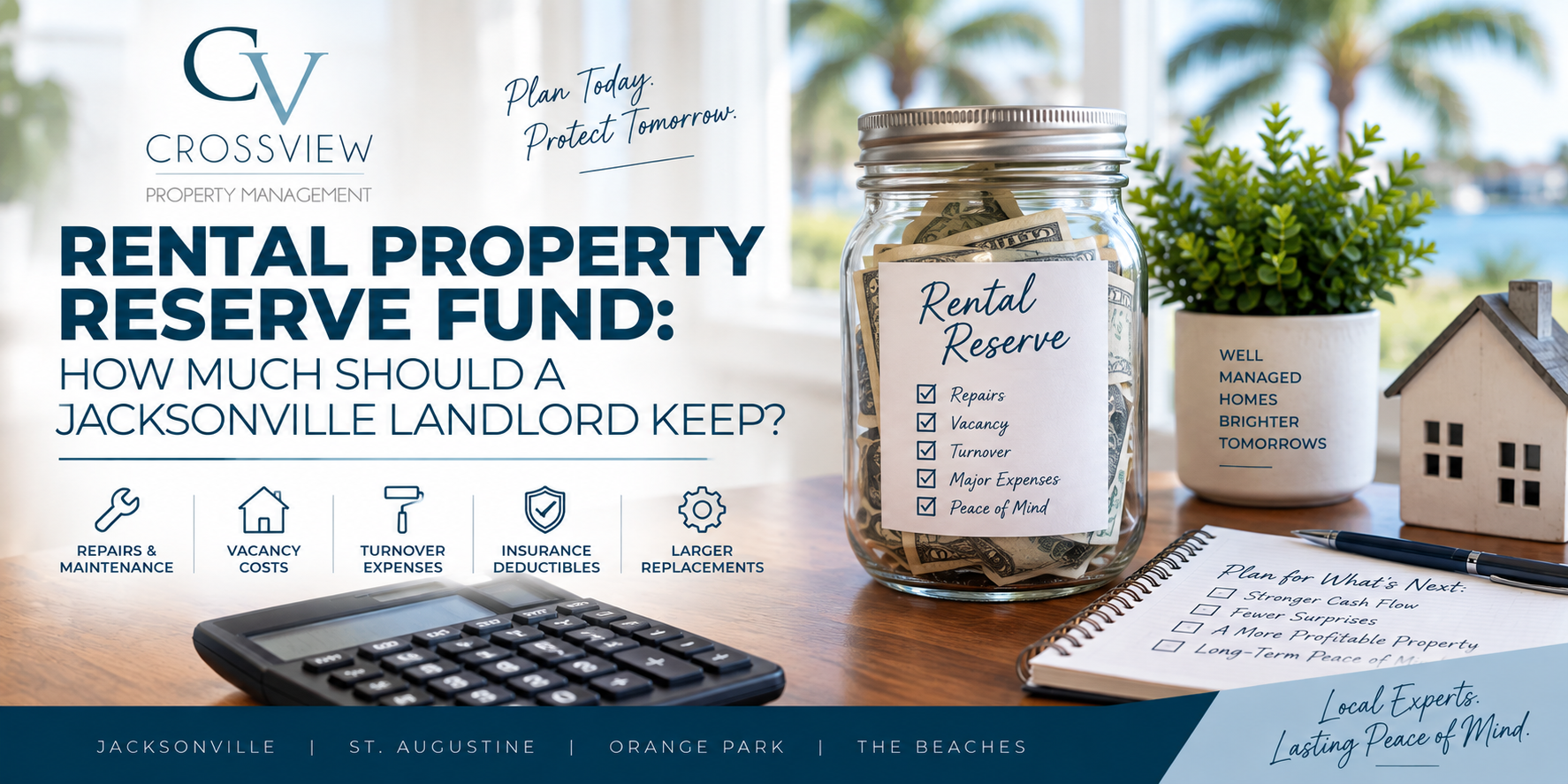
How much cash should you keep available for your Jacksonville rental property?
There isn’t one perfect reserve amount for every landlord. A useful rental property reserve fund should be large enough to handle routine repairs, a period of vacancy, turnover expenses, and at least some of the larger surprises that come with owning a home.
Because rental income tends to be predictable.
Repairs? Not so much.
A Rental Property Reserve Fund Is More Than Maintenance Money
When owners hear the word “reserve,” they often think about a broken faucet, a service call, or replacing an appliance.
Those things absolutely count.
But your financial cushion should usually account for more than routine maintenance.
Think of rental reserves in three buckets:
| Reserve Category | What It Helps Cover |
|---|---|
| Routine Maintenance | Plumbing calls, minor repairs, appliance issues, service visits |
| Operating Cushion | Vacancy, utilities during turnover, cleaning, lawn or pool service |
| Larger Property Expenses | HVAC replacement, water heater, major plumbing work, insurance deductible, larger repairs |
You may not need money from all three buckets in the same year.
Hopefully, you don’t.
But the fact that something hasn’t broken yet doesn’t mean it won’t.
Jacksonville rental owners also have some very Florida-specific realities to think about. Air conditioning works hard here. Heavy rain and storms happen. Water intrusion can become expensive quickly. And insurance deductibles may leave owners responsible for a meaningful portion of a covered loss.
A reserve gives you options when one of those expenses shows up.
So, How Much Should a Landlord Keep in Reserve?
This is where we don’t love giving every property owner the same magic number.
A newer townhome with recently replaced systems has a different risk profile than an older single-family home with an aging HVAC system, older roof, and original appliances.
Instead of choosing an arbitrary amount, look at the property itself.
Ask yourself:
- How old is the HVAC system?
- How old is the water heater?
- What condition are the roof and major systems in?
- Are the appliances newer or approaching replacement age?
- Is there an HOA?
- Does the property have a pool or other equipment to maintain?
- What is your insurance deductible?
- How much would one month without rental income affect you?
- If the tenant moved out tomorrow, could you comfortably pay for turnover and vacancy?
Those answers will tell you more than a generic formula.
Some owners prefer to build reserves gradually by setting aside part of the rent each month. Others maintain a larger cash cushion from the beginning.
Either approach can work.
The important part is that the reserve actually exists.
Not a credit card you hope has room on it.
Not next month’s rent.
Actual available funds.
If you’re still deciding whether a Jacksonville property works financially as a rental, our guide to evaluating whether renting out your home is worth it also walks through maintenance, vacancy, and cash-flow considerations.
Don’t Confuse Monthly Cash Flow With Available Cash
A rental can look profitable on paper and still leave an owner financially uncomfortable.
Let’s say the rent comes in every month, the mortgage gets paid, and there’s money left over.
Great.
But then the HVAC stops cooling in August.
Now you have a large expense that wasn’t part of this month’s normal cash flow.
This is why we encourage owners to think beyond:
Rent – Mortgage = Profit
There are more moving pieces.
Maintenance, property management, insurance, taxes, HOA expenses, vacancy, turnover, and eventual replacement of major components all affect what the property really costs to own.
You don’t necessarily need to spend reserve money every month.
Actually, the whole point is that you probably won’t.
You’re building a cushion for the month when the property needs it.
Our article explaining how CrossView handles rental property maintenance goes deeper into how we coordinate repair requests, communicate with owners, and work with vendors when something needs attention.
If you’re unsure what expenses to plan for with your particular property, that’s something we can discuss when reviewing the home. Request a call with CrossView Property Management and we can help you think through the property from a management perspective.
The Best Time to Build Your Reserve Is Before You Need It
This sounds obvious.
But it’s easy to put off when the property is behaving itself.
Everything is working.
The tenant is paying.
No major maintenance requests are coming in.
So that extra money starts looking available for something else.
Then something happens.
A resident gives notice. The property needs several repairs before it can go back on the market. A major appliance fails during turnover. Or you discover that two expenses you expected to happen years apart have decided to become best friends and arrive in the same month.
Rental properties do that sometimes.
Building reserves while things are calm is much easier than trying to find the money when something has already happened.
This also becomes more important as a property ages.
If you know the HVAC system, water heater, roof, or appliances are getting closer to the end of their useful life, your reserve strategy should reflect that.
You don’t have to predict exactly when something will fail.
You just need to acknowledge that eventually, something will need replacing.
How CrossView Property Management Helps
CrossView Property Management has managed rental homes throughout Jacksonville and Northeast Florida since 2018.
Part of professional management is helping owners understand that maintenance expenses don’t disappear just because somebody else is coordinating the work.
The property still belongs to you.
Our job is to help manage the process—communicating with residents, coordinating qualified vendors, documenting expenses, and keeping you informed when something needs attention.
CrossView does not mark up routine vendor repair invoices, which means maintenance isn’t designed to be another profit center for us. You can learn more in our breakdown of what is included in CrossView Property Management fees.
A property manager can coordinate the problem.
A good reserve helps you financially handle it.
Both matter.
The goal isn’t to have a giant pile of cash sitting around for no reason. It’s to keep a predictable rental investment from turning into a financial emergency because an unpredictable expense happened at the wrong time.
If you own a rental in Jacksonville, St. Augustine, Orange Park, The Beaches, or the surrounding Northeast Florida area, request a call with CrossView Property Management at (904) 855-7933.
We’d be happy to talk through your property, its current condition, and what professional management could look like for you.
Frequently Asked Questions About Rental Property Reserve Funds
Q: How much should I keep in a rental property reserve fund?
A: There isn’t one amount that fits every rental property. Consider the age and condition of the home, major systems, likely turnover costs, insurance deductible, monthly operating expenses, and how easily you could absorb a period without rent. An older property or one with aging major systems may justify a larger cushion than a newer property with recently replaced components.
Q: Is a rental property reserve fund the same as a maintenance budget?
A: Not necessarily. Maintenance should be part of your reserve planning, but owners may also need cash for vacancy, turnover, utilities between tenants, insurance deductibles, and larger replacements. Thinking beyond day-to-day repairs creates a more realistic financial cushion.
Q: Should I set aside rental income every month?
A: Many owners find that regularly setting aside part of the property’s income makes reserve planning easier. How much you set aside depends on the property and your existing cash position. The important thing is to avoid treating every dollar left after the monthly bills as immediately spendable profit.
Q: What are some of the biggest surprise expenses for a Jacksonville rental property?
A: HVAC problems, plumbing issues, appliance replacement, water-related repairs, storm damage, and turnover expenses can all create larger-than-normal bills. Not every property will experience all of those costs, and timing is impossible to predict. A reserve simply gives you more flexibility when an unexpected expense occurs.
Q: Does hiring a property manager mean I don’t need a reserve fund?
A: No. Property management helps coordinate operations, maintenance, tenant communication, documentation, and other responsibilities, but the property’s expenses still belong to the owner. Having accessible reserves makes it easier to respond when the property needs legitimate repairs or other owner-funded work.
About CrossView Property Management
CrossView Property Management is a full-service residential property management company serving Jacksonville, St. Augustine, Orange Park, The Beaches, and the surrounding Northeast Florida area. Since 2018, CVPM has helped property owners — investors, military families, second-home owners, and accidental landlords alike — protect and grow their rental investments through transparent communication and personalized care. CVPM is a proud member of NARPM, NHWA, and NEFAR.
CrossView Property Management · (904) 855-7933 · Rentals@crossviewpm.com. Equal Housing Opportunity. This article is general information only and does not constitute legal, tax, or financial advice. It is not a guarantee of rental income, occupancy, or investment performance. For specific questions about Florida landlord-tenant law, lease terms, or your property, consult an attorney or contact our team directly.