Landlord Recordkeeping in Florida: What Jacksonville Rental Owners Should Keep on File
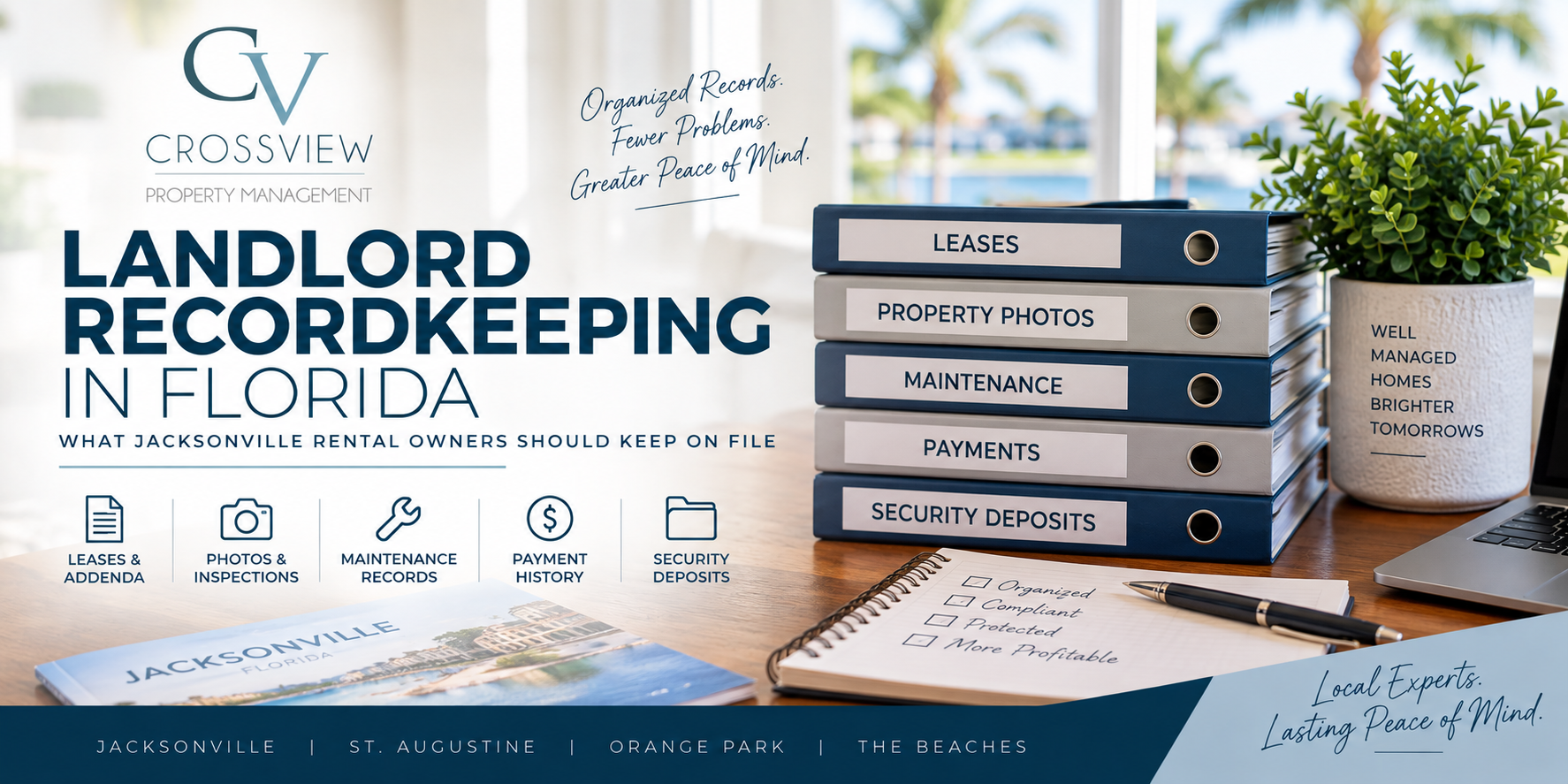
If someone asked you for the lease, move-in photos, last repair invoice, and rent payment history on your Jacksonville rental today, how quickly could you find them?
Good landlord recordkeeping means keeping the important documents related to your rental property organized, accessible, and secure throughout the tenancy. That includes more than the lease—it also means condition photos, payment records, maintenance invoices, notices, and other documentation that tells the story of what happened at the property.
Because six months from now, “I think that’s what happened” isn’t nearly as useful as having the record in front of you.
Start With the Lease and Property Documents
The signed lease is the foundation of the tenancy.
Keep the complete executed version—not an unsigned draft sitting somewhere in your email.
That file should also include any applicable addenda, amendments, renewal documents, property rules, and other agreements connected to the tenancy.
If something changes during the lease, keep that documentation with the original agreement rather than relying on a text message or memory later.
The same goes for important property-related documents.
Depending on the home, you may want an organized file for things like:
- Lease agreements and addenda
- Lease renewals or amendments
- HOA information that applies to the rental
- Property management documents
- Insurance-related property information
- Vendor or service agreements
- Relevant owner approvals
It doesn’t need to be complicated.
It does need to be organized.
Keep Move-In, Walk-Through, and Move-Out Documentation
Photos are one of the simplest records a rental property owner can keep.
And one of the most useful.
A good move-in record gives you a visual starting point for the tenancy. Instead of trying to remember what a wall, floor, appliance, or fixture looked like a year ago, you have documentation.
We’ve written more about why move-in photos matter for rental property owners.
The same principle applies throughout the tenancy.
At CrossView Property Management, our scheduled property visits are visual property condition walk-throughs—not professional home inspections. We document what we can reasonably observe while walking through the property and keep those records as another checkpoint during the tenancy.
Then, when the tenant moves out, you have something to compare.
Move-in.
During the tenancy.
Move-out.
That timeline is much more helpful than trying to reconstruct everything after the fact.
Save Maintenance Requests, Invoices, and Repair Records
Rental properties need maintenance.
That part isn’t optional.
What owners sometimes overlook is documenting what happened after the maintenance request came in.
If a tenant reports a plumbing concern, for example, you want to know:
- When was it reported?
- What did the tenant report?
- Was a vendor sent?
- What did the vendor find?
- What work was completed?
- What did it cost?
- Was additional work recommended?
Keep the work order, invoice, photos when available, and any significant communication associated with the repair.
That creates a maintenance history for the property.
Over time, those records can help you spot patterns, understand what you have spent, and answer questions about when something was repaired or replaced.
Our article on how CrossView handles rental property maintenance for Jacksonville owners explains more about how we coordinate repairs and provide owners with documentation.
Keep Clear Rent and Payment Records
You should be able to see what rent was due, what was paid, when it was paid, and whether there is an outstanding balance.
That sounds obvious.
Until somebody is trying to piece together twelve months of payments from bank deposits, text messages, and handwritten notes.
Keep a clear rent ledger or payment history.
Also document important financial items connected to the tenancy, including applicable fees, credits, owner-approved expenses, and other adjustments.
Good financial records also matter when tax time rolls around. Rental income and rental expenses need supporting documentation, so keep invoices, receipts, statements, and other records your tax professional may need.
For questions about what tax records you personally need to retain—and for how long—talk with your CPA or tax adviser. Retention requirements can depend on the type of record and your individual circumstances.
Security Deposit Documentation Deserves Its Own File
Security deposits are one area where you really don’t want scattered paperwork.
Keep the records associated with the deposit together.
That may include the lease provisions, required notices, payment records, move-in condition documentation, move-out documentation, repair invoices, correspondence, and any claim or return records.
Florida has specific requirements surrounding residential security deposits, so self-managing landlords should be careful not to treat this as a casual bookkeeping item.
We have a separate guide explaining how security deposits work for Florida landlords.
And when the tenancy ends, our Florida rental property move-out guide walks through the documentation and turnover process in more detail.
If you have a legal question about a security deposit claim, notice, or deadline, consult a Florida attorney for advice specific to your situation.
Don’t Forget Communication Records
Not every conversation needs to become a ten-page file.
But important communication should be documented.
If a tenant requests a significant repair, asks for a lease change, gives notice, reports damage, or discusses something that could matter later, make sure you have a reliable record.
The goal isn’t to document every “thanks” and “got it.”
It’s to make sure important decisions aren’t living only in someone’s memory.
And keep sensitive records secure.
Rental files can contain personal and financial information, so they shouldn’t be sitting in an unlocked drawer, a shared personal email account, or a random folder anyone can access.
How Long Should Florida Landlords Keep Rental Records?
This is where owners should be careful with blanket answers.
There isn’t one universal retention period that applies to every document connected with a rental property.
Tax records, contracts, deposit documentation, legal notices, maintenance records, and other documents may have different reasons for being retained.
Our general advice is simple: don’t throw away important rental documentation just because the tenancy ended.
Ask your CPA how long tax and financial records should be retained for your situation, and ask a Florida attorney when you have questions about legal documents, claims, or potential disputes.
Good recordkeeping is about being able to produce the right information when you need it—not keeping a garage full of banker boxes forever.
How CrossView Property Management Helps
One of the benefits of professional property management is that the owner doesn’t have to build the entire documentation system from scratch.
CrossView Property Management helps keep the moving pieces of a tenancy organized—from lease documents and property condition records to maintenance coordination, invoices, owner reporting, and move-out documentation.
That becomes especially valuable when you own multiple rentals or live outside Northeast Florida.
You don’t want to be searching through three email accounts trying to figure out who repaired the dishwasher eighteen months ago.
You want a process.
If you own a rental in Jacksonville, St. Augustine, Orange Park, The Beaches, or the surrounding Northeast Florida area, request a call with CrossView Property Management at (904) 855-7933. We’d be happy to show you how we keep owners informed and rental property records organized.
Frequently Asked Questions About Landlord Recordkeeping in Florida
Q: What records should a Florida landlord keep for a rental property?
A: Start with the signed lease and addenda, rent payment records, move-in and move-out condition documentation, maintenance requests, invoices, relevant tenant communications, and security deposit documentation. Owners should also maintain the financial records needed for rental income and expenses. The exact documents you need can vary depending on the property and tenancy.
Q: How long should landlords keep rental property records in Florida?
A: There isn’t one simple retention period that applies to every rental document. Tax, contractual, financial, and legal records can have different requirements and purposes. Your CPA can advise you about tax documentation, while a Florida attorney can answer questions about records connected with leases, claims, or disputes.
Q: Should landlords keep photos from move-in and move-out?
A: Yes. Photos create a visual record of the property’s condition at different points in the tenancy. They can be especially helpful when comparing the condition at move-out with the documented condition at move-in. Keep the photos organized by property and date so they’re actually useful later.
Q: Should I save every maintenance invoice for my rental property?
A: Keeping maintenance invoices is a good practice. They help document what work was completed, when it happened, what vendor performed the work, and how much it cost. Those records can also be useful for budgeting, future maintenance decisions, and tax preparation.
Q: Does a property manager keep records for the owner?
A: A property manager should have an organized process for maintaining records related to the services it performs. At CrossView Property Management, documentation is part of the overall management process, including leases, property condition records, maintenance information, invoices, and owner reporting. Owners should still keep their own important financial, tax, insurance, and ownership documents as appropriate.
About CrossView Property Management
CrossView Property Management is a full-service residential property management company serving Jacksonville, St. Augustine, Orange Park, The Beaches, and the surrounding Northeast Florida area. Since 2018, CVPM has helped property owners — investors, military families, second-home owners, and accidental landlords alike — protect and grow their rental investments through transparent communication and personalized care. CVPM is a proud member of NARPM, NHWA, and NEFAR.
CrossView Property Management · (904) 855-7933 · Rentals@crossviewpm.com. Equal Housing Opportunity. This article is general information only and does not constitute legal, tax, or financial advice. It is not a guarantee of rental income, occupancy, or investment performance. For specific questions about Florida landlord-tenant law, lease terms, or your property, consult an attorney or contact our team directly.